Showing posts with label bird-watching. Show all posts

Wednesday, 21 August 2013

Ghana


Two years goes quickly. It feels like only yesterday that Hannah and I landed at Kotoka airport in Accra, late in the night, wondering what life in Ghana would be like.

It wasn’t yesterday, of course; yesterday I was sipping a coffee in a trendy Berlin café, just around the corner from our new flat. The summer air was crisp compared to

Accra’s humid cloak; the pavement consisted of neatly arranged slabs, rather than an open sewer; the waitress came straight over to serve me, without having to be prodded awake first.

And yet I was missing Ghana. Berlin seems too calm, too organised. I miss the chaos: hawkers coming up to sell bead necklaces and phone credit; goats eating plastic bags and chickens pecking for seeds; the constant sounds of car horns and music; children playing in the streets; everyone smiling, whatever they’re doing.

Ghana was a wonderful home for two years. We visited a lot of the country – the geography geek in me was pleased that we spent time in all ten of Ghana’s regions – and were rewarded with some truly memorable experiences.

One highlight was Mole National Park, which compensates for its lack of big cats or migrating herds by getting visitors up close to its elephants. If you’ve never watched elephants mix up a mud bath before coating skin or playing together in a water hole, or had one look you directly in the eye from just a few metres away, then it’s worth visiting Ghana for this alone.

The bird walk and afternoon game drives were also rewarding. Our guides always managed to spot something special: a roan antelope through the dense bush or a colourful fruit pigeon hidden in the higher branches. Mole has plans to develop a luxury lodge, and the road from Tamale is being improved. Hopefully the park will maintain its understated charm despite these new developments.

Ghana’s main attraction is its tropical beaches. We explored much of the coast, from Beyin near the Cote D’Ivoire border to Keta Lagoon in the southeast. My favourite place was Green Turtle Lodge, a backpacker resort near Akwidaa – the perfect place to lie back in a hammock, drink beer with other travellers and wish you had thought of writing ‘The Beach’ first. Hannah’s pick was the more upmarket Fanta’s Folly near Butre, where the eponymous Nigerian owner serves delicious food flavoured with herbs picked from her husband’s garden. We also saw our one and only turtle in Ghana here. Closer to Accra, Till’s No.1 resort provided a quick weekend getaway from city life.

One of my motivations for moving to Ghana was to see the lesser-known parts of a country, something not always possible with shorter visits. The main outlet for this was the Ghana Mountaineers, a group of like-minded hikers gathered from across the world in Accra. We climbed Ghana's highest peak; we camped out under a full moon on Verandah Mountain; we completed Ghana’s own three peaks, Krobo, Iogaga and Osoduku; and we beat our own tracks through the hills of the Volta Region and beyond, literally in places: while many people visit Boti Falls, very few hack their way up the river to do it, battling snakes (OK, one sleeping snake), storms and the jungle on the route. Ghana has huge potential as a hiking destination; nothing too high or challenging, but fantastic views and a good infrastructure to get around easily.

If Ghana is easy to fall for, Accra takes a little longer to love. It’s a fast-developing city, with high-rise buildings going up on every spare corner of land, clearing the last few green spaces and trees as they go. Half-built concrete shells dominate the city’s skyline and as flats, hotels, offices and shopping malls come to life. Many of these changed little in two years, as the developers’ money runs out or they become mired in land disputes. Painted warnings claiming ‘land not for sale’ are a common sight, and anyone passing through Cantoments will see the red warnings on land: ‘Property of E.B. Tibboh – keep off’, although he never seemed to actually build anything.

Next to our flat in East Legon, an entire block of flats was constructed from scratch during our stay. As the bright orange outer panels coloured our neighbourhood and the vast satellite dishes were screwed on, the family living across the road sold simple meals of fufu and sauce to workers from the nearby repair yard and farms from their ramshackle wooden hut. The children, who worked there late into the night, sold me beer and tomato puree, insisting that I returned the bottles so they could get their deposits back. Every few pesawas counts for Accra’s poorer residents. And their simple business was a step up from those found in the poorest quarters, such as Jamestown.

Life in Accra had its moments, though. We enjoyed some fantastic food (none of it Ghanaian) in the capital’s many restaurants; I played football with former Ghana internationals at the British High Commission, and we watched the local derby, Hearts of Oak v Asante Kotoka, in the impressive national stadium; Hannah taught a former president’s grandson at Ghana International School; and on an unforgettable night at +233 jazz club, we joined our Canadian friends Andrew and Christie as part of a mass dance routine without being laughed off the floor by the more supple and rhythmic locals.

We also experienced an African election. After the build up, which saw the unexpected and widely mourned death of the president John Atta Mills, I had anticipated … what? Street riots? Tribal warfare? Perceptions of African democracy are probably tainted by those that make the news in the UK. But in the event, it was extremely quiet and democratic; there was more tension in the city during the two African Cup of Nations, in both of which Ghana made the semis. And lost.

There are many more memories: the primary school on Kpala island in Lake Volta powered by the playground roundabout; visiting the rice farmers in the Volta Region and hearing about the complexities of land acquisitions; experiencing the shrines and rituals of northern Ghana. Two years was long enough to enjoy the good things about the country, and we are leaving before the typically insignificant and indulgent expat frustrations – power cuts, heat stroke, traffic, bewilderment about the Ghanaian way of doing things –led to an even more unhealthy amount of Gulder beer being consumed.  

Hannah and I are both certain that we will return to Ghana, to visit friends, return to Mole and laze on the beach. But for now, as with half of the dishes listed on any Ghanaian menu … please, it is finished.

Friday, 5 April 2013

Tick lists

There’s no mistaking a birdwatching enthusiast. Zechariah, wearing a dark green uniform complete with an ancient-looking rifle over his shoulder, was waiting at the safari office in Mole National Park when I arrived at 5.45am. ‘I was up at four, looking for fishing owls’ he explained. ‘Didn’t see them, just heard them.’ This was a man who took twitching seriously.

Mole National Park
Seriously enough to knock on the door of the two guests who had failed to show up. He came back, shaking his head disbelievingly: ‘They didn’t come, because of the storm’. The downpour just an hour earlier had been torrential; it seemed a viable excuse to me. But I opted to hold my tongue.

It was soon my turn anyway. ‘You’re too young to be a birdwatcher’, he said, looking me up and down. ‘Do you have a camera and notebook?’ I told him that I wasn’t too serious about birdwatching, and just enjoyed seeing tropical birds. The look he gave me in response left me wondering if I would make it past the crocodiles in the water hole.

But credit where it’s due: Zechariah Wareh knows his birds. As we made our way down the steep escarpment in front of the Mole Motel, he picked out various weavers and seed-crackers and the colourful red-cheeked cordon-bleu. He knew them not just by sight, but also by call; while I tried to find one species through my binoculars, he was already calling out the next one. Mole has over 300 species of bird, and he seemed keen to show me all of them.
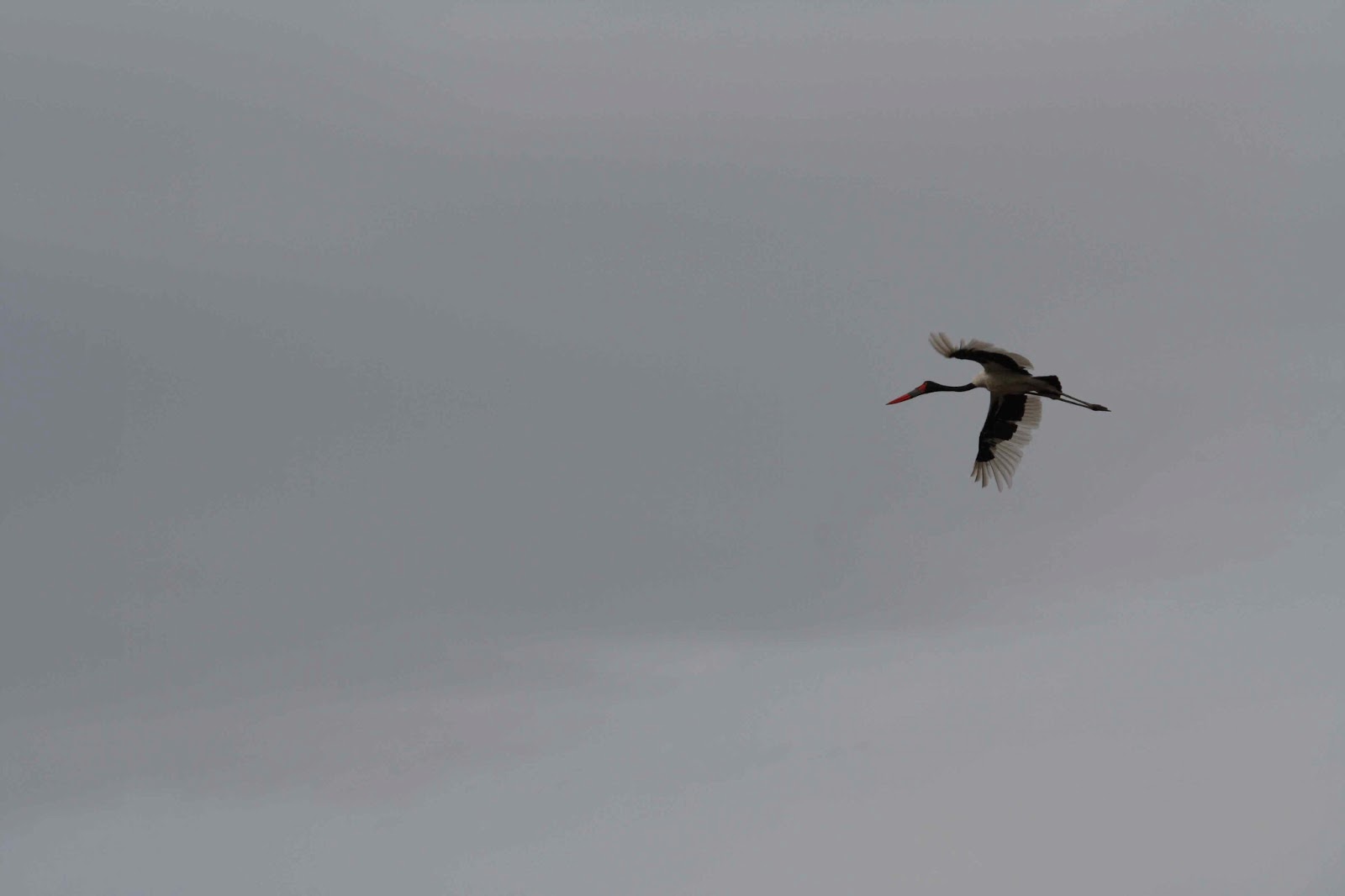
A red-billed stork

As we walked through the scrubby savannah forest, he mentioned how lucky I was to have him for this walk. He had been booked on a course, but as the other birding guide had called in sick, he had stayed to take me out. ‘I am in the Bradt guide’, he said, not boastfully but rightfully proud of his reputation.

He also told me about two avid twitchers who had spent nearly a week in the National Park looking for the rare painted snipe. ‘They are wasting their time; it has gone for the year’, he said emphatically. ‘I have told them.’ I was surprised that anyone would doubt his word on avian matters. 

Keen to redeem myself a little, I mentioned the red-billed stork I had seen the previous day. He smiled and nodded; I was starting to make amends for my lack of years or tick-list.

Crocs
For two hours, we wandered about, viewing gonoleks, starlings and vultures, among others. I lost count of the species we had seen, and was grateful I hadn’t had tried to keep a record. As we returned to the motel, we passed the crocodiles at the water hole. Zechariah stopped, admiring the creatures as they basked in the morning sun. It was warming that, after 25 years as a guide, he was still awed by a sight he must have seen nearly every day.

By this time I was hungry and, well, a little ‘birded out’. As I trotted quickly up the steps towards breakfast, Zechariah called me back. ‘Look, fruit pigeons – three different species’ he said, pointing to the colourful birds, which put their dour UK cousins to shame. I looked up, muttered something appreciative and then headed off for breakfast. Zechariah headed off to the office, and I was fairly sure he would be out there at 4.00am next day looking for his owls.

Saturday, 8 December 2012

Langma

Hannah birdwatching
After a fraught couple of days battling to get our passports back from the Ghana immigration office, Hannah and I needed some peace and quiet. And few places around Accra are quieter or more peaceful than Barbara’s Village, tucked away behind Langma beach. 

The ‘village’ is a circle of huts and stilt rooms modelled on Nzulezo village in western Ghana. On arrival, the resort was deserted apart from the eponymous Barbara and Moses, the barman/manager/handyman. The beach resorts in Langma probably lose many potential customers to the bright lights of Kokrobite, chiefly Big Milly’s, which are nearer Accra and better known. Barbara’s village also sits away from the beach, which is likely to put some off. But others’ loss was our gain; we dropped our bags in our hut and headed for the empty chairs around the bar.

Some sort of cactus
One of the many attributes of Barbara’s Village is the garden. The circular bar is surrounded by overhanging trees and an array of brightly coloured flowers and shrubs. These in turn attract the birds and I got out the binoculars to watch the weavers, shrikes and sparrows going about their business. Hannah joined in for once. “There’s a red one over there,” she nodded, barely looking up from her book as a Barbary shrike bounced about beneath the trees.

A barbary shrike

People head to the beaches around Accra to escape the city and enjoy some nature. So you cannot then complain if nature then surrounds you. But there are limits, even for ardent nature lovers like myself. The grass roofs of the huts match the traditional style for this part of Africa, but they also provide an ideal residence for mice. And the ones in our roof seemed to be indulging in a Led Zeppelin-style orgy, given the amount of banging and squeaking that went on.

A bronze mannekin

The rodents continued into the early hours, so with little chance of sleep I got up at dawn. The resort was louder at 6.00am than in the afternoon, with the birdlife in full song. I sat and watched the morning routines, as sparrows and bronze mannekins tended their nests in the rafters of the bar, and weavers flew across with more grass for their nests.

One of the legacies of the many foreign-owned beach bars along Ghana’s coast is the spread of proper coffee, in place of the filth that is Nescafe instant. When Moses appeared, I ordered a pot with which to enjoy the early morning activity. Barbara’s might be too quiet for some, but at that hour, it was perfect.

The bar

* Don't let the mice put you off visiting Barbara's Village. They have, according to Moses, been "dealt with".

Sunday, 2 December 2012

Aburi


Murder
Situated in the breezy Akapwem hills, Aburi is a popular day trip from Accra – an increasingly easy trip as the road-building project at Madina reaches its conclusion. And the usual target is the botanical gardens.

The gardens were created by the British in 1890, who decided the best thing to do was chop down all the native plants and put in foreign ones. I travelled there with Guy, a colleague visiting from the UK. Our first encounter with nature was a little unexpected. A luminous green spider scurried across the path where it was soon chased down by some ants. The battle was swift and ruthless; the ants quickly ripped a leg off, then overpowered the unfortunate arachnid and dragged him away to meet his fate. It was a gruesome sight so early on a Sunday morning; I loved it.

Strangler Fig
The garden’s star aboreal attraction is the Strangler Fig tree. This is a parasite that, over a period of 30 years, fed off its host tree and eventually killed it. The dead tree rotted away, leaving the Ficus standing with a hollow trunk where the host once was. For botanists, it’s a fascinating specimen that demonstrates parasitism. For everyone else, it’s a chance to stand inside a tree and stick your head out of the little holes.

A butterfly (somewhere)
But Guy was here for the butterflies, not trees. And the botanical gardens are full of them, so he spent an hour chasing them about, trying to get good photos with which to identify them later. This quickly wore us out and we headed to the restaurant for a drink and a snack. We enjoyed kelewele (spicy fried plantain) and yam chips (yams cut into chips). A bee-eater and a pied hornbill flew past as we ate; I was proud that my new birdwatching skills enabled quick identification without flapping through the field guide.

A flower (a red one)
A student from Royal Botanical Gardens at Kew founded these gardens, but they bear little resemblance to their neatly organised UK cousin. From the restaurant, a steep path led into what was nominally the citrus section, but essentially an overgrown jungle. An army of soldier ants paraded in line along the path. I gave them a wide berth, having already seen what they were capable of.

Guy enjoyed the multitude of butterflies in the forest, while I simply appreciated being out of Accra – one of Aburi’s key selling points. Eventually the mosquitoes drove us back to the main gardens and as it was approaching midday, the gardens were filling with picnicking families and noisy church groups. Another key tip to enjoying Aburi – arrive early.

Saturday, 24 November 2012

Kingfishers

Malachite kingfisher
It’s tough being a pied kingfisher in Ghana. These striking black and white birds were the first sighting on our morning bird walk. But the ten or so perched proudly on a wooden frame were quickly usurped by a showier relative. A burst of brilliant blue, with a flash of bright orange from its beak: a malachite kingfisher, darting across the water, quickly drew the focus of cameras and binoculars.

Sorting the morning catch
Samuel and David, our guides from Birdlife International and the Ghana Wildlife Society respectively, had arranged permission to explore the private grounds of Pambros salt ponds, in Accra’s western suburbs. Security was still tight, though, leading to the unusual sight of a birdwatching group having an armed guard.

Even this failed to perturb the women who were sorting and gutting fish caught in the salt ponds. They smiled as we walked past, with the familiar Ghanaian expression of amusement at what these foreigners think passes for fun at 7.00am on a Saturday.

As we headed slowly along the path, discussions typical of a birdwatching group took place. A debate on the different Dutch and English names for the whimbrel; a bit of lens-envy at some of the impressive camera equipment on show; a discussion of whether that hornbill was actually a cormorant.
Fishing on the delta

The salt ponds have undoubtedly changed the landscape here, with vast areas of the wetland bordered off and cleared of vegetation. But this has apparently had little impact on the populations or diversity of birds. Behind the salt ponds lies the Densu Delta, which enters the sea near Bojo Beach, and this provides a rich source of food and shelter.

The day’s tick-list filled quickly as we neared the end of the path. Reef herons sat in the delta bushes, while cormorants dried their wings in the sun. Black-winged stilts waded gracefully through the shallow water, fishing alongside sandpipers and redshanks. And on the sandbank just before us, the pied kingfishers dived back and forth, hoping to finally get their moment of glory.

Pambros salt ponds

Saturday, 27 October 2012

Birds

Legon botanical gardens
In a city with few green spaces, the University of Legon’s botanical gardens are a haven for those needing some fresh air. Wandering around the disorganised collection of trees and shrubs quickly takes you away from the noise and fumes of Accra’s busy streets. On any given weekend, you will find many of the city’s dog walkers and joggers treading the brick-red paths, and students reading quietly underneath trees. 

The gardens also attract much of the city’s wildlife, particularly the avian kind. And so at 7.00am I took a taxi to the northern end of the campus to join the birdwatching walk run by BirdlifeInternational and the GhanaWildlife Society.

A shikra
Confession time: I am something of a reluctant birdwatcher. Despite being a nature lover, I always considered watching tiny specks in the distance and making notes on them a rather geeky pastime, only one or two steps up from trainspotting. But before we moved to Ghana, a friend from TCV told me about the diversity of birds in West Africa (he had lived in Nigeria) and recommended a good field guide.

And I have become hooked. Sort of. I don’t take notes or make lists: no recording of the overhead conditions, or numbers of males and females. I am also a bit of snob. I have no interest in all the little brown ones, or pigeons or crows – I can see them back in the UK. Luckily Ghana many brightly coloured species with suitably tropical names; more than enough to occupy a fledgling twitcher.

Samuel, the walk leader, set us off at a lazy pace. Within a few steps we had found our first specimens: a couple of grey hornbills calling to each other. I had seen them before hopping between the trees in Accra, but this was a chance to admire them more closely. We stopped to watch their routine, some in the group taking notes, others photos.

A grey hornbill
Further along we saw green wood hoopoes, two handsome shikras, glossy purple starlings and a blue-bellied roller – brightly coloured, easy to spot and exotic-sounding, so instantly one of my favourites. I was impressed by the number of different species Samuel was picking out – far more than I had managed on my solo efforts here.

While he set up the telescope – or ‘scope’ to us birdwatchers (I was learning the lingo fast) – a bird moved through the trees further away. “Tim, can you have a look at what that was?”

The pressure was on – would my identification skills pass the test? I could sense a dozen pencils poised, waiting for my expert opinion. Sweat dribbled into my eyes, and the binoculars (or ‘bins’) trembled as my fingers fumbled on the focus.

“Er, I think it was another hornbill” I said, trying to sound authoritative.
“Great, thanks, mark that one down.”

Relief; I had passed the test. (I think the sage nodding of the head helped to convince people I was an old hand.)

A cattle egret
The highlight of the walk near the pond on the northern edge of the park. I already knew this place well for its large colony of cattle egrets, noisy white birds that nest in the trees, and whose toxic droppings make area fairly pungent. But ‘Uncle’, a senior member of the group, had spotted something far more exotic – a yellow-fronted tinkerbird, high up in the tree.

We took turns looking through the lens at this beautiful little creature, while Uncle smiled proudly at our admiration. I asked him how he had spotted such a small bird, so high up. “I heard its call, and knowing they like to sit high up, I managed to find it,” he replied.

His skills put my clumsy, ‘play it safe’ guess at a hornbill into perspective; I have a long way to go as a birdwatcher. Luckily the botanical gardens provide the perfect training ground.

Photos by Rene Mayorga

Sunday, 14 October 2012

Cockerels

Cockerel
There’s no need for an alarm clock in Wli. The local cockerels provide a free wake-up call, competing to see how can screech the loudest. The problem is you can’t set them for a particular time. And so, I was roused at 4.30am – more than an hour before the scheduled start of our walk to Wli’s upper waterfall.

Wli waterfalls, a combination of two falls that together form the highest in West Africa, is one of the Volta Region’s most popular attractions. The usual approach is along the floor to the lower falls, but James and I had signed up for the route along a mountain ridge to the upper falls.

Looking across the valley
We met Samuel, our guide, at the Wli tourist office at 6.00am. Wli village was already busy; women and girls swept the yards, while a local bar already had music playing. And the souvenir sellers who line the path to the falls were already setting up their stalls, ready for the earliest arrivals. Clearly the cockerels do a thorough round of the village.

Samuel, with Mt Afadjato behind
We enjoyed the cool morning air as we climbed steadily, following the steep southern shoulder of the bowl that contains the falls. After 45 minutes we paused above a sheer rock face. As we sat, a West African River Eagle swooped past. It nearly dropped the branch in its beak, before performing a clumsy mid-air juggling act and gliding off nonchalantly, pretending nothing had happened.

As we followed its flight round to the cliff face where its nest no doubt lay, our gaze was drawn to Mount Afadjato to the south. This is Ghana’s highest mountain, if only by a few metres, but it looked suitably imposing for the title, rising up from the early-morning haze that hid the villages below.

A short climb further and we reached the forest that covers the top of the hillside. Hidden in the grass lay planks of wood, clearly cut by a mechanical saw.
Wli Upper Falls
‘Togolese’, said Samuel. ‘They come up here to steal wood and smuggle it across the border.’
‘But why don’t they cut wood in Togo’ enquired James.
‘And why do they cut wood in the forests right at the top of the hill, not lower down?’ I asked.
‘And do they really drag a mechanical saw all the way up here?’
‘Yes, Togolese’ repeated Samuel, emphatically. Discussion over. And neither of us could come up with a better explanation as to how they got there.

From the contraband wood, the path headed steeply into the chamber. Tree roots and vines provided vital handholds during the precarious descent, and the brief glimpses of the upper falls provided little distraction from the task at hand. After a final, vertical slide through mud, rock and bush, we finally reached level ground again and continued quickly to the falls.

James
The water cascaded from high overhead, dispersing into spray before it reached the plunge pool. The spray soaked us in seconds, providing instant refreshment in the morning heat. On the opposite side of the falls was a path leading uphill. ‘The path to Togo’, said Samuel solemnly. No doubt used by those pesky wood smugglers.

"Numerous bats"
After admiring the falls, we headed quickly downhill to reach the main footpath. After passing the colony of bats that live near the falls – modestly promoted in the region as Wli’s “numerous bats” – we returned to the comfort of Wli Water Heights Hotel to shower, shower again, and then eat.

From the hotel’s courtyard, you can just see the waterfall, as well as the many other hills that crowd this beautiful corner of Ghana. And so we settled in for an afternoon of the scenery it from a distance while the hotel’s friendly waiter brought a steady supply of well-earned beers. It had been an early start thanks to the cockerels, but at least Wli is suitably sleepy during the rest of the day.

View from the hotel


Wednesday, 26 September 2012

Move


Our new flat is in East Legon, in northeast Accra. It’s the first, and probably last, time I will live in a city’s trendiest quarter.

You can tell it’s trendy because the taxi drivers ask Hannah and me for double the normal city fares – even on top of their standard obroni tax. We can usually haggle them down, but one or two have got very irate when they felt they hadn’t ripped us off sufficiently. Another refused to take us for less than 10 cedis (for what should be a 3-cedi journey), arguing, “I will then have to turn round to come back”. True, perhaps, but failing to grasp one of the key aspects of taxi driving.

Dzorwulu, our old quarter, was a suburb for wealthy Ghanaians, but East Legon is a suburb aimed at young middle-class Ghanaians and expats, who are spilling out here now the smartest districts, Airport Residential and Cantonments, are full. Flashy new restaurants line Lagos Avenue and Freetown Avenue, with many more being built. New houses and flats are also going up, their grey concrete skeletons springing up on every spare bit of land.

The lesser-spotted air-conditioning repair man
Our own flat is new. It’s bright, shiny, and suitably trendy for East Legon, with white leather sofas and a flat-screen TV. But pick away at the mahogany-finish, stuck-on surface and the cracks quickly appear. The list of faults is too long and dull to list, but is epitomised by the front door. Strong, sturdy and shiny … but put on back to front. So the lock is on the outside, and you have to put your shoulder to it to close it properly. A new one is being shipped from China (everything is imported from China). The other problems will be fixed tomorrow. Definitely tomorrow.

The back of our flat overlooks one of Accra’s few rivers. It’s not quite a Ghanaian equivalent of Wind in the Willows; you are more likely to see a chicken pecking about in the sludgy trickle than a water rat in a rowing boat. Unfortunately, like most waterways in the city, it’s used as a rubbish dump. And as there is nowhere else to dump it, where else should it go? Our security guards set fire to the pile when it gets too high.

The river does, though, provide a green and leafy view, with trees lining either side. As I approach middle age, I can justify keeping a bird watching book by my desk, which overlooks the river. And my new binoculars help to determine whether that flash of red and yellow is a Barbary shrike or a Shoprite carrier bag blowing in the wind.