Showing posts with label wildlife. Show all posts

Wednesday, 21 August 2013

Ghana


Two years goes quickly. It feels like only yesterday that Hannah and I landed at Kotoka airport in Accra, late in the night, wondering what life in Ghana would be like.

It wasn’t yesterday, of course; yesterday I was sipping a coffee in a trendy Berlin café, just around the corner from our new flat. The summer air was crisp compared to

Accra’s humid cloak; the pavement consisted of neatly arranged slabs, rather than an open sewer; the waitress came straight over to serve me, without having to be prodded awake first.

And yet I was missing Ghana. Berlin seems too calm, too organised. I miss the chaos: hawkers coming up to sell bead necklaces and phone credit; goats eating plastic bags and chickens pecking for seeds; the constant sounds of car horns and music; children playing in the streets; everyone smiling, whatever they’re doing.

Ghana was a wonderful home for two years. We visited a lot of the country – the geography geek in me was pleased that we spent time in all ten of Ghana’s regions – and were rewarded with some truly memorable experiences.

One highlight was Mole National Park, which compensates for its lack of big cats or migrating herds by getting visitors up close to its elephants. If you’ve never watched elephants mix up a mud bath before coating skin or playing together in a water hole, or had one look you directly in the eye from just a few metres away, then it’s worth visiting Ghana for this alone.

The bird walk and afternoon game drives were also rewarding. Our guides always managed to spot something special: a roan antelope through the dense bush or a colourful fruit pigeon hidden in the higher branches. Mole has plans to develop a luxury lodge, and the road from Tamale is being improved. Hopefully the park will maintain its understated charm despite these new developments.

Ghana’s main attraction is its tropical beaches. We explored much of the coast, from Beyin near the Cote D’Ivoire border to Keta Lagoon in the southeast. My favourite place was Green Turtle Lodge, a backpacker resort near Akwidaa – the perfect place to lie back in a hammock, drink beer with other travellers and wish you had thought of writing ‘The Beach’ first. Hannah’s pick was the more upmarket Fanta’s Folly near Butre, where the eponymous Nigerian owner serves delicious food flavoured with herbs picked from her husband’s garden. We also saw our one and only turtle in Ghana here. Closer to Accra, Till’s No.1 resort provided a quick weekend getaway from city life.

One of my motivations for moving to Ghana was to see the lesser-known parts of a country, something not always possible with shorter visits. The main outlet for this was the Ghana Mountaineers, a group of like-minded hikers gathered from across the world in Accra. We climbed Ghana's highest peak; we camped out under a full moon on Verandah Mountain; we completed Ghana’s own three peaks, Krobo, Iogaga and Osoduku; and we beat our own tracks through the hills of the Volta Region and beyond, literally in places: while many people visit Boti Falls, very few hack their way up the river to do it, battling snakes (OK, one sleeping snake), storms and the jungle on the route. Ghana has huge potential as a hiking destination; nothing too high or challenging, but fantastic views and a good infrastructure to get around easily.

If Ghana is easy to fall for, Accra takes a little longer to love. It’s a fast-developing city, with high-rise buildings going up on every spare corner of land, clearing the last few green spaces and trees as they go. Half-built concrete shells dominate the city’s skyline and as flats, hotels, offices and shopping malls come to life. Many of these changed little in two years, as the developers’ money runs out or they become mired in land disputes. Painted warnings claiming ‘land not for sale’ are a common sight, and anyone passing through Cantoments will see the red warnings on land: ‘Property of E.B. Tibboh – keep off’, although he never seemed to actually build anything.

Next to our flat in East Legon, an entire block of flats was constructed from scratch during our stay. As the bright orange outer panels coloured our neighbourhood and the vast satellite dishes were screwed on, the family living across the road sold simple meals of fufu and sauce to workers from the nearby repair yard and farms from their ramshackle wooden hut. The children, who worked there late into the night, sold me beer and tomato puree, insisting that I returned the bottles so they could get their deposits back. Every few pesawas counts for Accra’s poorer residents. And their simple business was a step up from those found in the poorest quarters, such as Jamestown.

Life in Accra had its moments, though. We enjoyed some fantastic food (none of it Ghanaian) in the capital’s many restaurants; I played football with former Ghana internationals at the British High Commission, and we watched the local derby, Hearts of Oak v Asante Kotoka, in the impressive national stadium; Hannah taught a former president’s grandson at Ghana International School; and on an unforgettable night at +233 jazz club, we joined our Canadian friends Andrew and Christie as part of a mass dance routine without being laughed off the floor by the more supple and rhythmic locals.

We also experienced an African election. After the build up, which saw the unexpected and widely mourned death of the president John Atta Mills, I had anticipated … what? Street riots? Tribal warfare? Perceptions of African democracy are probably tainted by those that make the news in the UK. But in the event, it was extremely quiet and democratic; there was more tension in the city during the two African Cup of Nations, in both of which Ghana made the semis. And lost.

There are many more memories: the primary school on Kpala island in Lake Volta powered by the playground roundabout; visiting the rice farmers in the Volta Region and hearing about the complexities of land acquisitions; experiencing the shrines and rituals of northern Ghana. Two years was long enough to enjoy the good things about the country, and we are leaving before the typically insignificant and indulgent expat frustrations – power cuts, heat stroke, traffic, bewilderment about the Ghanaian way of doing things –led to an even more unhealthy amount of Gulder beer being consumed.  

Hannah and I are both certain that we will return to Ghana, to visit friends, return to Mole and laze on the beach. But for now, as with half of the dishes listed on any Ghanaian menu … please, it is finished.

Thursday, 11 July 2013

Burkina Faso pt III: Peaks

Sindou Peaks
The Sindou Peaks in southwest Burkina Faso are an astonishing geological spectacle. Across the millennia, the elements have carved these giant columns into a stunning array of shapes and sculptures. Today, these dazzling maroon formations are a giddying sight, enough to send you head over heels – and straight down the rocks below.

Sandstone may be the perfect material for allowing Mother Nature to get creative, but the small pile of dust and blood at my feet proved that its structural qualities are less noteworthy. “Some of the rocks are not very strong”, confirmed Paul, our guide, in French. Helpful advice, especially when delivered before you start climbing them.

Ow
Once my cuts were cleaned and I’d checked my ego for bruising, Paul continued our walk. He led us nimbly through the crevasses to the best vantage points from which to appreciate the surrounding Senoufo villages and lush farmland, vibrant with tall stalks of sugar cane. Looking out, he explained how entire villages trek into the hills for religious ceremonies. Tourists used to be allowed to attend these, and even camp on the plateau, but visits are now limited to day treks. “The campers left too much rubbish”, Paul said, solemnly. “People didn’t respect the importance of this place.”

Hiking through the peaks
After two hours of exploring, we descended back to our car. Hannah and I had been a little daunted about heading out into rural Burkina Faso. It’s one of Africa’s poorest countries, and there is little in the way of organised tours. But an unofficial grapevine exists between the excellent hotels in the southwest region. The manager of the Villa Bobo hotel in Bobo Diolasso had made all our arrangements in advance, and Metina, our affable driver, had met us at Banfora’s scruffy bus station.

The haggling for our two-day tour around the region had been simple. Metina had typed a figure into his calculator – 50,000 CFA (around £65) for two days including petrol – and we had quickly agreed.  He used the calculator because he couldn’t read or write, and later told us that he used the money from his tours to pay for his grandchildren – 37 and counting – to go to school so they could learn.

Hippos
After the morning’s rock-climbing-and-falling excitement, the second stop on Banfora’s tourist circuit was far more leisurely: a trip to see the hippos on Tengréla Lake. As at Sindou, the facilities for tourists were basic but well organised. Metina introduced us to the owners of the small guesthouse on the lake shore. Five minutes later, we set off in a hand-carved pirogue for the northern end of the lake, while he kicked back with a coke.

For anyone used to safaris in East or Southern Africa, wildlife watching in West Africa is a remarkably health-and-safety-free experience. We glided silently through the water lilies resting on the lake until we could see the hippos right in front of us. Then we went a bit closer. Then closer still.

Now that's a hat
With our boatman showing little sign of stopping, I urgently recalled enough French to ask, as calmly as possible: “Is this close enough?”
“It’s ok, the hippos are happy today,” replied our guide nonchalantly.

I’m not entirely sure how you gauge the mood of a pod of hippos just from their ears, which were all that showed above the water’s surface. But my French definitely wasn’t up to asking, so instead, we watched the huge beasts from just a few metres away. I divided my time between taking photos and calculating if I could paddle to the shore faster than a hippo could swim, should something snap one of them from his good humour.

Hours drift by peacefully at Tengréla. Herons waded through the shallows, competing for the lake’s fish with the local men. Hornbills peeped loudly from the trees overhanging the lake. Children waved frantically as they made their way home from school – white tourists are still a novelty here. The sun pounded down relentlessly. After two hours, it had become too hot and we turned back for a cooling drink. The hippos had barely twitched so much as an ear; perhaps that’s how you tell that they’re content.

A cow

Thursday, 4 July 2013

Burkina Faso pt 1: Nazinga


Elephants
Safaris in West Africa are different to those in East or southern Africa. There are no big cats in the reserves (none that you see, at least); the camps tend to be basic concrete rooms rather than luxury tents; and there is a wonderful disregard for health and safety.

A ground hornbill
Finding elephants on a safari in Kenya a few years ago, our driver kept his vehicle in reverse, ready to make a swift retreat if necessary. But when we discovered a small herd in Burkina Faso’s Nazinga Game Ranch, our driver simply parked up and got out; I half-expected him to pull out a picnic rug.

Hammerkop
They had taken a bit of finding. Nazinga is rarely visited, so there is no network of guides radioing each other with sightings; it’s just a question of luck whether you see them or not. After two hours’ rattling around dirt roads in a decrepit 4x4 (doors held on by string, cardboard for the rear window), we had seen hammerkops and bizarre-looking ground hornbills, but no sign of the elephants.

Our transport
I was thinking we were going to be unlucky; the elephants tend to head into the bush during the rainy season. But then our guide spotted them. He led Hannah and I slowly through the trees to get a better view as they trudged slowly towards a nearby water hole. One of the larger females eyed us warily as we approached, and a couple of them turned ominously towards us.

Our guide led us quickly onto the road; were we sensibly returning to the relative safety of the vehicle? Not a bit of it: we crouched down on the open road and watched, from no more than 10 metres away, as the giants thundered across before us, more than 20 animals in total. It was a brief encounter, but one well worth the effort of travelling to this remote corner of Burkina Faso.

Why did the elephant cross the road?

Sunday, 12 May 2013

Terrapins


The road to Krobo
The markers along the early drive to Krobo were all present and correct: stalls of bread sellers at Ashaiman; baboons lingering outside the Shai Hills; early morning joggers on the Akosombo road; the police reluctantly waving our car through their checkpoint, the diplomatic number plates meaning no ‘dash’ this time.

This was my seventh trip up Krobo and the route was equally familiar. I knew every rock along the way, despite the tall grass obscuring the path. But even well-trodden hills can throw up surprises.

Snake!
Just beyond the short rock climb, Carolyn spotted a small grey snake crossing the path. This was the first snake I had seen on Krobo, and only the third in two years in Ghana – a welcome rare sighting. The bulge midway along its length suggested we were slightly less likely to see a mouse on route. After pausing while we took its picture, it slid off to digest its meal in peace.

A baby terrapin
An even bigger surprise was waiting at the top. In among the rocks at the summit is a small pool of water, which had been recently replenished by the rain. Something bobbing near the surface caught my eye; was that really a baby terrapin? I looked again and saw another further along, and another climbing the side of the pool. As we admired them, the mother, hidden in the grass, splashed into the water and disappeared into the depths of the murky pool.

Route-finding
It’s a mystery how they got there; there’s no other standing water for a long way, and the sides of Krobo are surely too steep for a terrapin to climb (and why would they bother?) Could a bird have dropped one while flying overhead? Could there be a cave system hidden within the hill, connecting them to rivers below? It is likely to remain a mystery for quite some time.

This wasn’t just a simple stroll up Krobo, however; our group continued to Stone Lodge through the scrubby plains of lowland Ghana. We took a bearing – none of this GPS nonsense, just binoculars and a compass – and set off due south.

Krobo in the background
Aside from the occasional thicket of trees, and ditches formed by cattle that were now filled with water, the route was fairly straightforward. But 14km is a long way in the heat of Ghana; as we reached Stone Lodge three hours later, I considered the fact that most of our fellow expats would – like the Krobo terrapins – have opted for a day swimming in the pool rather than a hike in the midday sun.

Thursday, 11 April 2013

Butterflies


Not Kumasi
The Lonely Planet’s West Africa guidebook says ‘Kumasi is worth as much time as you can give it’. Hmm … my first five minutes in Ghana’s second city were spent picking a route through Kajeita market – through open sewers, ankle-deep rubbish, and street traders who cover the pavement with cheap plastic tat and piles of fruit. Five minutes was more than enough time for me.

Perhaps the best way to enjoy Kumasi is not to live in Accra. The ‘sizzling street food’, ‘colourful markets’ and ‘bustling/vibrant/hectic/pulsating nightlife’ may be exciting the first time, but the novelty quickly wears off. Kumasi had the same hassles, traffic and potent stenches that Hannah and I were escaping for two weeks.

That evening we got food poisoning from an expensive Indian restaurant and were greeted in our hotel room by a cockroach the size of a cat. I was more than happy to leave Kumasi early the next morning to explore the countryside of the Ashanti region.

*****
Lake Point Guesthouse
It’s an unfair comparison: a crowded city of 1.6 million people versus a tranquil lakeside retreat. But Lake Bosumtwe felt a world away from Kumasi. Formed by a meteorite several millennia ago, the near-perfectly round lake is surrounded by quiet fishing villages and forested peaks – not a bustling market in sight.

We took a taxi to Lake Point Guesthouse on the western shore of the lake. Our room was charmingly furnished with local materials and adornments. In the garden, birds flitted between the flowers and star fruits, mangoes, bananas and oranges hung from the branches of the various trees. I could feel the grime of Kumasi leaving me instantly.

Star fruit
We spent the day lazing by the lake, reading books and playing scrabble. Beside the lake, the only noise came from the raucous weaverbirds that were nesting in the reeds. The shallow lake water was as warm as a bath, and an eagle swooped overhead as I swam. This was my kind of place.

It’s hard not to fall into the relaxed vibe of life beside the lake. Unfortunately the staff at Lake Point had done likewise. The next day, we asked about the lunch menu – a limited but tasty selection of soups with bread or toasted sandwiches. We were told that they had run out of bread at breakfast and were waiting to get some more.

A cattle egret relaxing at the lake
Breakfast had finished four hours ago; the nearest village, complete with a stall selling bread, was a mere 10 minutes’ walk away. I asked if they could get some bread: ‘Someone has gone already’. When will they be back? ‘I don’t know’.  Can you prepare soup and bread when they are back, and bring it to us? ‘No, you must wait.’

It’s a minor gripe, and lethargic customer service is hardly a new complaint in Ghana. And if you’re going to wait for two hours for a bowl of soup, there are few more relaxing places to do it than Lake Bosumtwe.

*****
A butterfly
The Ashanti region is Ghana’s traditional heartland, as well as being the source of much of the country’s wealth, particularly from the region’s goldmines. There are plenty of craft villages nearby, but as with bustling markets, you only need to see Kente weaving once to get the idea. Instead, we decided to visit Bobiri butterfly sanctuary. 

It was a good decision. Situated just off the Kumasi–Accra road, the forest sanctuary is surprisingly well preserved considering that logging has decimated much of the region’s forests. And you don’t have to go far to see its eponymous residents.
Another butterfly

There were butterflies on every bush in the garden as we dropped off our bags; several different species flitted about on the road through the forest; one or two even found their way into the sanctuary’s guesthouse. Filling in the guestbook, I noted the previous visitor was ‘disappointed not to see any butterflies’; I wondered exactly where he had been looking.
'I saw her first...'
 
We were soon on a forest trail with James – the only wildlife guide who wears polished slip-on shoes and an ironed white shirt. He identified the different trees and told us how people use each one. He also explained the threats facing Ghana’s forests as the demand for timber rises – part of the forest is selectively logged. 

The forest was also alive with many of the 400 butterfly species recorded in the sanctuary. Although how anyone records them is beyond me – butterflies rarely sit still long enough to be examined, the little scamps.

Breakfast at Bobiri
That evening, we relaxed in the sanctuary’s guesthouse, a painted wooden house built on stilts. It felt like a trip back from the 1930s – sipping drinks on the terrace, looking out to the forest. The only thing missing from a full Happy Valley experience was the wife swapping – not easy when you’re the only guests –although two of the resident tortoises were scrapping over a lady. (If you’ve never seen lovesick tortoises fighting, I can assure you it’s very entertaining.)

I stretched out, beer in hand and with the sounds of the rain forest all around. Kumasi may delight backpackers, and Bosumtwe has its charms, but for me, Bobiri and its butterflies are the highlight of the Ashanti region.

Monday, 8 April 2013

Hippos


A hippo
Weichau hippo sanctuary feels a long way from anywhere. We rattled along the bumpy, potholed road from Mole National Park for four hours before reaching the sanctuary’s visitor centre. Jo, our guide, showed us inside while KK, our driver, surveyed his mud-splattered car with the look of a man who regretted spending an hour washing it that morning. After paying the entrance fee, I asked Jo where the hippos were. ‘We have to drive; it’s another 22km along a dirt road’. KK didn’t look like he wanted to see hippos anymore; I was beginning to wonder myself.

We headed towards the Black Volta River, past the small communities who together created the sanctuary. I should have admired this remarkable community-based ecotourism project; instead I wondered when it was lunchtime and if it was too late to head for a hotel in Wa.

A young hippo
A dugout canoe was waiting on the river, which flows along the border between Ghana and Burkina Faso. We climbed in and were paddled upstream. And just five minutes later, we saw them. A bloat of hippos, submerged in the centre of the river. They rose one by one to snort out air, nudge each other or, on several occasions, fart loudly.

We pulled into the undergrowth on the Burkinabe side of the river and watched them. There’s something enthrallingly special about being 20 metres from wild hippos – about as close as I’d want to be. As each head appeared slowly, it was hard to shake the feeling they were keeping an eye on us, checking that we were keeping our distance.

The hippos have been protected since 1999, when the local communities created the sanctuary to generate a bit more tourism revenue in this quiet corner of Ghana. The scheme has been a success: visitor numbers have increased steadily and so, more importantly, have hippo numbers.

Our canoe
Numbers may get a further boost shortly. The hippos in Bui National Park, further along the Black Volta, are under threat from the new hydropower dam. Weichau sanctuary and Ghanaian wildlife groups hope they will move upstream. They will have to make their own way, though; no one has yet offered to move these giant, grumpy beasts. There are also doubts whether the land around Weichau could support more hippos. There’s plenty of space in the water – the problems will arise when they come on land to graze, threatening local crops.

Hidden in the shade, with the two young hippos now jumping on each other, it would have been easy to stay for longer. But tummies were rumbling; I illegally entered Burkina Faso for a quick piss, and we headed back to Weichau, leaving the hippos to enjoy their serene sanctuary.

*****
Ghana does tropical storms like few other countries, and the one during our night camping near the river was a classic. The lightning was so bright that the cockerels started crowing at 3.00am, thinking it was morning. We had to move our tent in the middle of the night to avoid a drenching.

Next morning, our charcoal burner was too wet too cook breakfast on, so we headed into Weichau village to eat. Jo took us to Yussif’s Tea Spot, whose motto is ‘Call in for all kinds of beverages’. As long as it’s Lipton Yellow Label tea. Still, at least Yussif acknowledged how lacking in flavour this shameful British brand is and put two bags into my plastic mug.

Mmm, Lipton!
Four of our six eggs had survived the storm and were soon being turned into an omelette. The tins of Heinz baked beans caused a problem, however. After explaining to Yussif that they didn’t go in the omelette, he then tried to fry them. It took a bit of discussion – Yussif was mute, so Hannah and I first had to explain to Jo how to cook beans, and he then signed this to Yussif. The expression on Jo’s face when he ate them was similar to my first fufu experience – people actually like this stuff? – but he ate them all, and Yussif’s fine breakfast restored our spirits after a wet night.
Mmm, beans!

Sipping my syrupy tea, I revised my opinion from the previous day. Weichau is a wonderful place and the local people deserve huge credit for their project. It’s well worth visiting – just don’t expect the journey there to be easy. And maybe leave the beans behind.

Friday, 5 April 2013

Tick lists

There’s no mistaking a birdwatching enthusiast. Zechariah, wearing a dark green uniform complete with an ancient-looking rifle over his shoulder, was waiting at the safari office in Mole National Park when I arrived at 5.45am. ‘I was up at four, looking for fishing owls’ he explained. ‘Didn’t see them, just heard them.’ This was a man who took twitching seriously.

Mole National Park
Seriously enough to knock on the door of the two guests who had failed to show up. He came back, shaking his head disbelievingly: ‘They didn’t come, because of the storm’. The downpour just an hour earlier had been torrential; it seemed a viable excuse to me. But I opted to hold my tongue.

It was soon my turn anyway. ‘You’re too young to be a birdwatcher’, he said, looking me up and down. ‘Do you have a camera and notebook?’ I told him that I wasn’t too serious about birdwatching, and just enjoyed seeing tropical birds. The look he gave me in response left me wondering if I would make it past the crocodiles in the water hole.

But credit where it’s due: Zechariah Wareh knows his birds. As we made our way down the steep escarpment in front of the Mole Motel, he picked out various weavers and seed-crackers and the colourful red-cheeked cordon-bleu. He knew them not just by sight, but also by call; while I tried to find one species through my binoculars, he was already calling out the next one. Mole has over 300 species of bird, and he seemed keen to show me all of them.
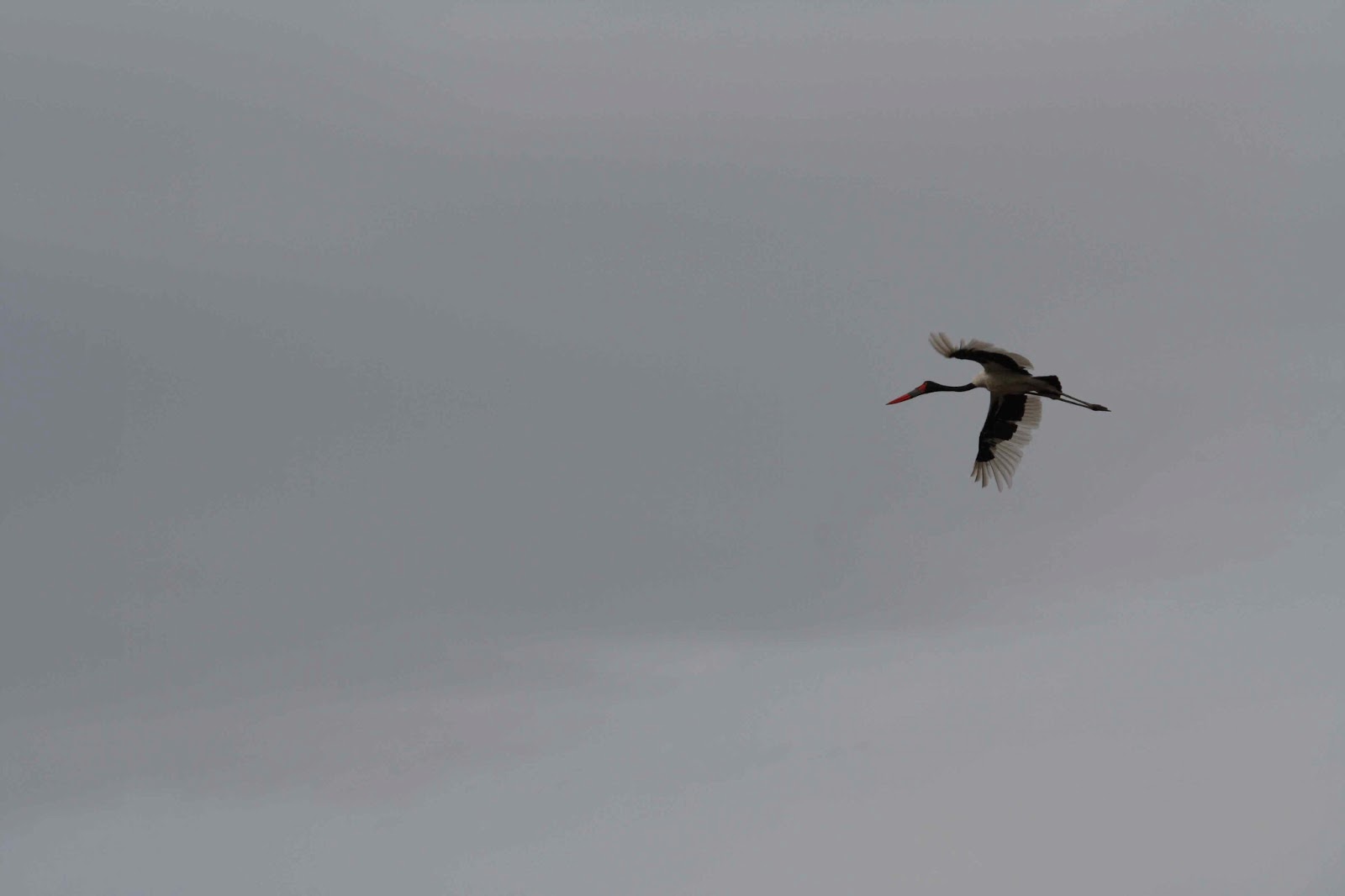
A red-billed stork

As we walked through the scrubby savannah forest, he mentioned how lucky I was to have him for this walk. He had been booked on a course, but as the other birding guide had called in sick, he had stayed to take me out. ‘I am in the Bradt guide’, he said, not boastfully but rightfully proud of his reputation.

He also told me about two avid twitchers who had spent nearly a week in the National Park looking for the rare painted snipe. ‘They are wasting their time; it has gone for the year’, he said emphatically. ‘I have told them.’ I was surprised that anyone would doubt his word on avian matters. 

Keen to redeem myself a little, I mentioned the red-billed stork I had seen the previous day. He smiled and nodded; I was starting to make amends for my lack of years or tick-list.

Crocs
For two hours, we wandered about, viewing gonoleks, starlings and vultures, among others. I lost count of the species we had seen, and was grateful I hadn’t had tried to keep a record. As we returned to the motel, we passed the crocodiles at the water hole. Zechariah stopped, admiring the creatures as they basked in the morning sun. It was warming that, after 25 years as a guide, he was still awed by a sight he must have seen nearly every day.

By this time I was hungry and, well, a little ‘birded out’. As I trotted quickly up the steps towards breakfast, Zechariah called me back. ‘Look, fruit pigeons – three different species’ he said, pointing to the colourful birds, which put their dour UK cousins to shame. I looked up, muttered something appreciative and then headed off for breakfast. Zechariah headed off to the office, and I was fairly sure he would be out there at 4.00am next day looking for his owls.

Tuesday, 26 February 2013

Sierra Leone part 2: Mount Bintumani


Arriving at Sinekoro just after midday, Kevin, Miriam and I were keen to make up for the time lost driving around the farthest corners of Sierra Leone. Not so fast … things are not rushed in this part of the world.

Sinekoro
First we had to meet the chief of Sinekoro and the village elders, to ask permission to climb Mount Bintumani and hire a guide and porter. The first part was easy; we were welcomed as the first visitors that year, the River Seli having only just dropped sufficiently to allow cars through. The second part not so: “They are all off in their fields; you will have to go tomorrow”. 

On the way
 This was not an attractive proposition in a village without any obvious supply of beer. Fortunately Alusine, our driver, once again came to the rescue. After a long discussion in Krio that involved most of the village and a lot of pointing, it was agreed that Hassan and Moses, two teenagers, would take us and we could leave straight away. We repacked our bags, watched by a crowd of excitable schoolchildren, and set off towards Bintumani.

Shortly after leaving the village and its farms we reached the rain forest that covers much of the Loma Mountains, of which Bintumani is the highest peak. The forest canopy was alive with bird calls and even the occasional howl from a monkey; always hidden from view but seeming close nonetheless. The sunlight glistened through the leaves and we saw colourful flowers and peculiar fruits. I marvelled at the experience of being in an unspoilt montane rain forest: the sights, the sounds, the smells.

In the rain forest
For about an hour. By then, my T-shirt was drenched, my heavy backpack was dragging me back down the steep slope, and the forest was no longer an environmental wonder, but rather a collection of spiky green things that caught my clothes, tripped me up or flicked into my eyes.

Hassan
And our first proper break provided little respite. Camp 1 is the first water refilling point on the path, making it an obvious stopping place, but it was also overrun with bees when we arrived. They buzzed around our heads and between our legs, around our drinks and food. One brave soul then made its way up my shorts. In case it needed clarifying, an angry bee in your pants is not a pleasant experience; after some frantic swatting and swearing, and one dead bee later, we set off once more on the steep path through the forest.

After four hours, I had had enough. Our guides showed little awareness of our exhaustion or heavy packs (they hadn’t offered to carry them), hurrying us along without a rest. Having finally caught up with Moses, I asked impatiently what the rush was. “Hassan is afraid of the forest, and I am afraid of the dark”, he told me simply. So much for our fearless guides.
Camp fire
They were no doubt as relieved as us to reach the forest edge, where the shoulder of the slope breaks abruptly into a clearing – Camp 2, our target for the day. It was instantly clear why people go to such effort to climb Mount Bintumani. The view across the Loma Mountains was unforgettable: the sun was setting behind an endless expanse of misty peaks that arose from the surrounding carpet of forest. I found a rock still warm from the sun, lay back and admired the spectacular scene below me.

Hassan made a fire, on which we were soon cooking dinner. We ate beans and drank tea with the calls of baboons, chimpanzees and antelope coming from the surrounding forest.

The Loma Mountains
*****

First glimpse of the summit
After a quick breakfast, Moses led the way to the summit. The route was easier than the previous day, across open grassland broken only by patches of forest in the small valleys. The grass is burnt each year – possibly by farmers, possibly by natural fires – and the charred clumps gave the landscape an other-worldly feel as we approached the rocky summit peak.

To the top
The Loma Mountains are protected, partly as a forest reserve but perhaps more by their inaccessibility. There is little logging or hunting in the forest and the region is still full of wildlife, albeit mostly hidden from sight. We saw a troop of baboons, several rock hyraxes and a lone buffalo grazing far below. But it was easy to believe that much more lives among the slopes and forests of the mountains, safely away from almost all human interference.

The final climb
That remoteness became apparent for a different reason as we neared the final steep climb through the rocks to the summit. Normally I would ascend such a climb with little concern, but I was suddenly aware that I was a long, long way from any form of help. A day and a half from Sinekoro; another bumpy day’s journey from Kabala, and I wasn’t even sure there was a hospital there. With some extremely careful bum-shuffling, in spite of a still-raw bee sting, I made it carefully up the slope and onto the summit plateau.

Regardless of how high, or how demanding the climb, the summit routine is always the same. A drink, a snack, a photo – this time complete with the Ghana Mountaineers banner Kevin had lugged all the way from Accra – and then back down.

At the summit
We picked up Hassan at Camp 2 and descended through the forest. Going downhill through the rain forest was no easier – leaf litter doesn’t make a good path – and my legs were barely functioning as we neared the village again.

Alusine was waiting for us, fairly impatiently. He hadn’t called his boss – or, more importantly, his wife – for three days, with no mobile coverage in the bush, and he was keen to get going. His nephew also looked ready to go home, and will probably think twice about offering directions again.

A plant
Caked in sweat and mud from the walk, I pondered whether we should get into his car before washing; I wouldn’t have let three such filthy people into my car. But then I wouldn’t have driven my car through the bush, across deep rivers or along narrow motorbike tracks. Alusine was clearly a more laid-back soul than me, or maybe it wasn’t his car. We waved goodbye to villagers of Sinekoro and piled in.

Bumping along the road, I looked back on our trip, not least the mistakes we had made. We hadn’t taken a map; our guides hadn’t brought any food or shelter (they shared ours); I hadn’t considered that Sinekoro would have no tourist facilities beyond a committee of elders to make things even more difficult. And the hike had taken us to an extremely remote location, without doubt the furthest I had ever been from civilisation. But if you go looking for an adventure, you can’t complain if you find one. And Mount Bintumani is certainly an adventure.

Mount Bintumani