Showing posts with label ecotourism. Show all posts

Thursday, 4 July 2013

Burkina Faso pt 1: Nazinga


Elephants
Safaris in West Africa are different to those in East or southern Africa. There are no big cats in the reserves (none that you see, at least); the camps tend to be basic concrete rooms rather than luxury tents; and there is a wonderful disregard for health and safety.

A ground hornbill
Finding elephants on a safari in Kenya a few years ago, our driver kept his vehicle in reverse, ready to make a swift retreat if necessary. But when we discovered a small herd in Burkina Faso’s Nazinga Game Ranch, our driver simply parked up and got out; I half-expected him to pull out a picnic rug.

Hammerkop
They had taken a bit of finding. Nazinga is rarely visited, so there is no network of guides radioing each other with sightings; it’s just a question of luck whether you see them or not. After two hours’ rattling around dirt roads in a decrepit 4x4 (doors held on by string, cardboard for the rear window), we had seen hammerkops and bizarre-looking ground hornbills, but no sign of the elephants.

Our transport
I was thinking we were going to be unlucky; the elephants tend to head into the bush during the rainy season. But then our guide spotted them. He led Hannah and I slowly through the trees to get a better view as they trudged slowly towards a nearby water hole. One of the larger females eyed us warily as we approached, and a couple of them turned ominously towards us.

Our guide led us quickly onto the road; were we sensibly returning to the relative safety of the vehicle? Not a bit of it: we crouched down on the open road and watched, from no more than 10 metres away, as the giants thundered across before us, more than 20 animals in total. It was a brief encounter, but one well worth the effort of travelling to this remote corner of Burkina Faso.

Why did the elephant cross the road?

Sunday, 26 May 2013

Afadjato


Mount Afadjato. Not that huge.
Mount Afadjato is Ghana’s highest mountain, reaching 885m. But the usual nicknames given to a country’s highest point are not applied here; no one describes it as ‘the rooftop of Ghana’, for example. And as you arrive at the base at Liati Wote, it’s easy to see why: Ghana’s highest mountain is surrounded by taller ones.

On the way to the top
Even the nearest peak, just across the road in the village, looks bigger. As our group from the Ghana Mountaineers pulled on walking boots and paid our hiking fees, I asked Justice, our guide, if the nearby hill was actually in Togo, given how close we were to the border. “No, but it’s much harder to reach the top”, he replied. It seems Afadjato is not even the tallest in its village; its image was quickly becoming irredeemably tarnished.

A signpost
The answer lies in the complexities of measuring summits and descents in between high points, a familiar issue to anyone who has tried to distinguish between Munros, Corbetts and Grahams in the UK. On the route up, Justice explained that the higher peaks nearby form part of a ridge that switches between Ghana­ and Togo. So while there are higher points in Ghana, Afadjato is the highest freestanding peak.

Hot, sweaty and having just been sick
I think that’s right; Justice wasn’t entirely sure, and didn’t really seem to understand why it mattered. He had a point; a good walk is a good walk, and Afadjato is certainly that. A steep path leads up its western face, with a couple of rocky climbs that provide a nod towards its ‘mountain’ status. And the views at the summit are superb: the Agumatsa Hills, coated by a dark green forest, stretch for miles to the north and south.

Also visible from the top is Tagbo Falls and after descending the hill, we continued along the low-level path to this beautiful waterfall set in a lush forested amphitheatre. The walk up Afadjato had worked up a sweat and Stephen, Quaysie and I splashed under the water to cool off. Once refreshed, we could reflect on our earlier achievement – climbing the highest hill in Ghana that’s not partly in Togo or a bit tricky to get to. Now that’s some achievement.

Tagbo Falls

Thursday, 11 April 2013

Butterflies


Not Kumasi
The Lonely Planet’s West Africa guidebook says ‘Kumasi is worth as much time as you can give it’. Hmm … my first five minutes in Ghana’s second city were spent picking a route through Kajeita market – through open sewers, ankle-deep rubbish, and street traders who cover the pavement with cheap plastic tat and piles of fruit. Five minutes was more than enough time for me.

Perhaps the best way to enjoy Kumasi is not to live in Accra. The ‘sizzling street food’, ‘colourful markets’ and ‘bustling/vibrant/hectic/pulsating nightlife’ may be exciting the first time, but the novelty quickly wears off. Kumasi had the same hassles, traffic and potent stenches that Hannah and I were escaping for two weeks.

That evening we got food poisoning from an expensive Indian restaurant and were greeted in our hotel room by a cockroach the size of a cat. I was more than happy to leave Kumasi early the next morning to explore the countryside of the Ashanti region.

*****
Lake Point Guesthouse
It’s an unfair comparison: a crowded city of 1.6 million people versus a tranquil lakeside retreat. But Lake Bosumtwe felt a world away from Kumasi. Formed by a meteorite several millennia ago, the near-perfectly round lake is surrounded by quiet fishing villages and forested peaks – not a bustling market in sight.

We took a taxi to Lake Point Guesthouse on the western shore of the lake. Our room was charmingly furnished with local materials and adornments. In the garden, birds flitted between the flowers and star fruits, mangoes, bananas and oranges hung from the branches of the various trees. I could feel the grime of Kumasi leaving me instantly.

Star fruit
We spent the day lazing by the lake, reading books and playing scrabble. Beside the lake, the only noise came from the raucous weaverbirds that were nesting in the reeds. The shallow lake water was as warm as a bath, and an eagle swooped overhead as I swam. This was my kind of place.

It’s hard not to fall into the relaxed vibe of life beside the lake. Unfortunately the staff at Lake Point had done likewise. The next day, we asked about the lunch menu – a limited but tasty selection of soups with bread or toasted sandwiches. We were told that they had run out of bread at breakfast and were waiting to get some more.

A cattle egret relaxing at the lake
Breakfast had finished four hours ago; the nearest village, complete with a stall selling bread, was a mere 10 minutes’ walk away. I asked if they could get some bread: ‘Someone has gone already’. When will they be back? ‘I don’t know’.  Can you prepare soup and bread when they are back, and bring it to us? ‘No, you must wait.’

It’s a minor gripe, and lethargic customer service is hardly a new complaint in Ghana. And if you’re going to wait for two hours for a bowl of soup, there are few more relaxing places to do it than Lake Bosumtwe.

*****
A butterfly
The Ashanti region is Ghana’s traditional heartland, as well as being the source of much of the country’s wealth, particularly from the region’s goldmines. There are plenty of craft villages nearby, but as with bustling markets, you only need to see Kente weaving once to get the idea. Instead, we decided to visit Bobiri butterfly sanctuary. 

It was a good decision. Situated just off the Kumasi–Accra road, the forest sanctuary is surprisingly well preserved considering that logging has decimated much of the region’s forests. And you don’t have to go far to see its eponymous residents.
Another butterfly

There were butterflies on every bush in the garden as we dropped off our bags; several different species flitted about on the road through the forest; one or two even found their way into the sanctuary’s guesthouse. Filling in the guestbook, I noted the previous visitor was ‘disappointed not to see any butterflies’; I wondered exactly where he had been looking.
'I saw her first...'
 
We were soon on a forest trail with James – the only wildlife guide who wears polished slip-on shoes and an ironed white shirt. He identified the different trees and told us how people use each one. He also explained the threats facing Ghana’s forests as the demand for timber rises – part of the forest is selectively logged. 

The forest was also alive with many of the 400 butterfly species recorded in the sanctuary. Although how anyone records them is beyond me – butterflies rarely sit still long enough to be examined, the little scamps.

Breakfast at Bobiri
That evening, we relaxed in the sanctuary’s guesthouse, a painted wooden house built on stilts. It felt like a trip back from the 1930s – sipping drinks on the terrace, looking out to the forest. The only thing missing from a full Happy Valley experience was the wife swapping – not easy when you’re the only guests –although two of the resident tortoises were scrapping over a lady. (If you’ve never seen lovesick tortoises fighting, I can assure you it’s very entertaining.)

I stretched out, beer in hand and with the sounds of the rain forest all around. Kumasi may delight backpackers, and Bosumtwe has its charms, but for me, Bobiri and its butterflies are the highlight of the Ashanti region.

Monday, 8 April 2013

Hippos


A hippo
Weichau hippo sanctuary feels a long way from anywhere. We rattled along the bumpy, potholed road from Mole National Park for four hours before reaching the sanctuary’s visitor centre. Jo, our guide, showed us inside while KK, our driver, surveyed his mud-splattered car with the look of a man who regretted spending an hour washing it that morning. After paying the entrance fee, I asked Jo where the hippos were. ‘We have to drive; it’s another 22km along a dirt road’. KK didn’t look like he wanted to see hippos anymore; I was beginning to wonder myself.

We headed towards the Black Volta River, past the small communities who together created the sanctuary. I should have admired this remarkable community-based ecotourism project; instead I wondered when it was lunchtime and if it was too late to head for a hotel in Wa.

A young hippo
A dugout canoe was waiting on the river, which flows along the border between Ghana and Burkina Faso. We climbed in and were paddled upstream. And just five minutes later, we saw them. A bloat of hippos, submerged in the centre of the river. They rose one by one to snort out air, nudge each other or, on several occasions, fart loudly.

We pulled into the undergrowth on the Burkinabe side of the river and watched them. There’s something enthrallingly special about being 20 metres from wild hippos – about as close as I’d want to be. As each head appeared slowly, it was hard to shake the feeling they were keeping an eye on us, checking that we were keeping our distance.

The hippos have been protected since 1999, when the local communities created the sanctuary to generate a bit more tourism revenue in this quiet corner of Ghana. The scheme has been a success: visitor numbers have increased steadily and so, more importantly, have hippo numbers.

Our canoe
Numbers may get a further boost shortly. The hippos in Bui National Park, further along the Black Volta, are under threat from the new hydropower dam. Weichau sanctuary and Ghanaian wildlife groups hope they will move upstream. They will have to make their own way, though; no one has yet offered to move these giant, grumpy beasts. There are also doubts whether the land around Weichau could support more hippos. There’s plenty of space in the water – the problems will arise when they come on land to graze, threatening local crops.

Hidden in the shade, with the two young hippos now jumping on each other, it would have been easy to stay for longer. But tummies were rumbling; I illegally entered Burkina Faso for a quick piss, and we headed back to Weichau, leaving the hippos to enjoy their serene sanctuary.

*****
Ghana does tropical storms like few other countries, and the one during our night camping near the river was a classic. The lightning was so bright that the cockerels started crowing at 3.00am, thinking it was morning. We had to move our tent in the middle of the night to avoid a drenching.

Next morning, our charcoal burner was too wet too cook breakfast on, so we headed into Weichau village to eat. Jo took us to Yussif’s Tea Spot, whose motto is ‘Call in for all kinds of beverages’. As long as it’s Lipton Yellow Label tea. Still, at least Yussif acknowledged how lacking in flavour this shameful British brand is and put two bags into my plastic mug.

Mmm, Lipton!
Four of our six eggs had survived the storm and were soon being turned into an omelette. The tins of Heinz baked beans caused a problem, however. After explaining to Yussif that they didn’t go in the omelette, he then tried to fry them. It took a bit of discussion – Yussif was mute, so Hannah and I first had to explain to Jo how to cook beans, and he then signed this to Yussif. The expression on Jo’s face when he ate them was similar to my first fufu experience – people actually like this stuff? – but he ate them all, and Yussif’s fine breakfast restored our spirits after a wet night.
Mmm, beans!

Sipping my syrupy tea, I revised my opinion from the previous day. Weichau is a wonderful place and the local people deserve huge credit for their project. It’s well worth visiting – just don’t expect the journey there to be easy. And maybe leave the beans behind.

Friday, 5 April 2013

Tick lists

There’s no mistaking a birdwatching enthusiast. Zechariah, wearing a dark green uniform complete with an ancient-looking rifle over his shoulder, was waiting at the safari office in Mole National Park when I arrived at 5.45am. ‘I was up at four, looking for fishing owls’ he explained. ‘Didn’t see them, just heard them.’ This was a man who took twitching seriously.

Mole National Park
Seriously enough to knock on the door of the two guests who had failed to show up. He came back, shaking his head disbelievingly: ‘They didn’t come, because of the storm’. The downpour just an hour earlier had been torrential; it seemed a viable excuse to me. But I opted to hold my tongue.

It was soon my turn anyway. ‘You’re too young to be a birdwatcher’, he said, looking me up and down. ‘Do you have a camera and notebook?’ I told him that I wasn’t too serious about birdwatching, and just enjoyed seeing tropical birds. The look he gave me in response left me wondering if I would make it past the crocodiles in the water hole.

But credit where it’s due: Zechariah Wareh knows his birds. As we made our way down the steep escarpment in front of the Mole Motel, he picked out various weavers and seed-crackers and the colourful red-cheeked cordon-bleu. He knew them not just by sight, but also by call; while I tried to find one species through my binoculars, he was already calling out the next one. Mole has over 300 species of bird, and he seemed keen to show me all of them.
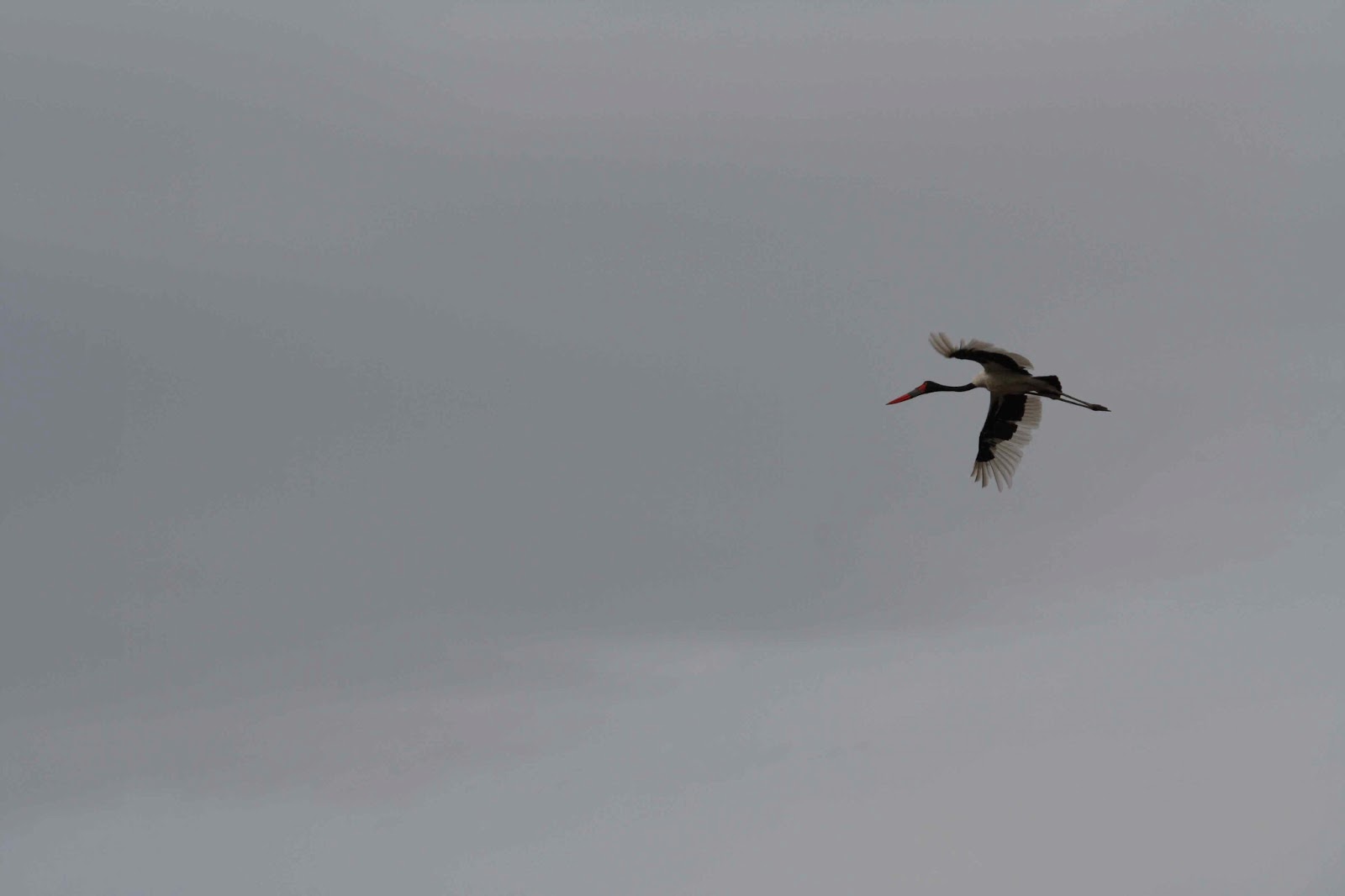
A red-billed stork

As we walked through the scrubby savannah forest, he mentioned how lucky I was to have him for this walk. He had been booked on a course, but as the other birding guide had called in sick, he had stayed to take me out. ‘I am in the Bradt guide’, he said, not boastfully but rightfully proud of his reputation.

He also told me about two avid twitchers who had spent nearly a week in the National Park looking for the rare painted snipe. ‘They are wasting their time; it has gone for the year’, he said emphatically. ‘I have told them.’ I was surprised that anyone would doubt his word on avian matters. 

Keen to redeem myself a little, I mentioned the red-billed stork I had seen the previous day. He smiled and nodded; I was starting to make amends for my lack of years or tick-list.

Crocs
For two hours, we wandered about, viewing gonoleks, starlings and vultures, among others. I lost count of the species we had seen, and was grateful I hadn’t had tried to keep a record. As we returned to the motel, we passed the crocodiles at the water hole. Zechariah stopped, admiring the creatures as they basked in the morning sun. It was warming that, after 25 years as a guide, he was still awed by a sight he must have seen nearly every day.

By this time I was hungry and, well, a little ‘birded out’. As I trotted quickly up the steps towards breakfast, Zechariah called me back. ‘Look, fruit pigeons – three different species’ he said, pointing to the colourful birds, which put their dour UK cousins to shame. I looked up, muttered something appreciative and then headed off for breakfast. Zechariah headed off to the office, and I was fairly sure he would be out there at 4.00am next day looking for his owls.

Sunday, 17 February 2013

Lagoon


Tudu station
A long journey by tro-tro – the clunky minibuses that serve as Ghana’s bus network – can be viewed in two ways. It can be a window into typical Ghanaian life: the chatter among the passengers; the sights along the way, such as the hawkers that crowd the windows at every stop; or the radio programmes, which could be anything from vibrant highlife music to a phone-in testing Bible knowledge.

Or it can be a complete pain in the arse. Literally; the cushions on most seats lost any sense of padding years ago. Our trip to Keta Lagoon started firmly in the latter camp. Forty-five minutes through Accra’s horrendous traffic to Tudu bus station; an hour waiting for the tro-tro to fill up; then another trip back across the city. Sweaty, cramped and irritable, we passed our flat on the outskirts of Accra nearly three hours after leaving it.

Guinea pigs
Ultimately, the pay-off in these journeys lies in the destination. And Meet Me There ecolodge, near Keta Lagoon in Ghana’s southeast corner, made the stiff backs worthwhile. The lodge’s main attraction is its small saltwater lagoon for swimming, and the menagerie in the grounds: guinea pigs, rock pythons, two dwarf crocodiles and several dogs, including three very playful puppies. The resident goats had given birth that day, and their kid stumbled about while they carried on eating. Bright red fire finches and seedcrackers competed for the seeds in the sand. I even had a crab nip my little toe, something I didn’t think happened outside of Beano cartoons.

A West African dwarf crocodile
The only sad note was the vervet monkey, which is kept chained up in the corner. The future for this creature, and all the other animals, should be release in a nature reserve, which the owners are trying to create nearby. This is, naturally, taking a long time to negotiate with local people and landowners. Hopefully for the monkey’s sake, it won’t take much longer.

*****

After spending most of Saturday lazing by the lagoon and playing with the puppies, Hannah and I decided to explore the local area that afternoon. I had an urge to see the Volta Estuary; it must be something to do with studying geography.

We caught a tro-tro for the (mercifully short) distance to Atetite, a small town by the river. As we stood, wondering which way to head, a man came over and introduced himself as Prospect – many Ghanaians have wonderfully descriptive names like this; maybe it’s where the Spice Girls got the idea. Having just finished his shift as a taxi driver, Prospect offered to show us around.

Atetite beach
The next two hours were probably the best tour we have had in Ghana. Prospect showed us the stunning beach by the estuary, an expanse of bright white sand completely devoid of litter, beach huts, anything except a few fishermen. Just behind the beach was a series of small lagoons, similar to the one at Meet Me There and dotted with wading birds and lined with palm trees. We wandered slowly, soaking up the serenity of this unspoilt corner of Ghana.

It’s perhaps surprising that the beach is so unspoilt, but two factors preserve its underdeveloped nature. The region hard to reach, being several miles off the Keta loop road, which itself lies some distance of the Accra–Togo road.

The other factor is the severe coastal erosion in this part of Ghana. The thin strip of land that separates the vast Keta Lagoon from the sea is being rapidly eaten away and is threatened by sea level rise, despite the efforts to reinforce the land. Maybe that is also deterring investors. But, for now at least, it is one of Ghana’s finest coastal destinations.

Smoking fish
After leaving the beach, Prospect introduced us to the people in his village and the nearby farms. A group of women showed us how they smoke the small fish caught nearby, and children ran out of their huts, smilingly demanding to be photographed. This informal tour was a stark contrast to the organised tour to Nzulezo; there, the daily stream of tourists has understandably made people resentful of people poking around their homes, or indifferent at least. In Atetite, every person we met waved, smiled or stopped to shake hands.

Only on our tro-tro journey back to Meet Me There did we find someone not pleased to see us. A small baby, wrapped tightly to her mother’s back, took one glimpse at my white face and started howling, a petrified look in her eyes. The wailing got louder, much to the amusement of the other passengers. “She doesn’t like you because you are white”, explained an old man, laughing racistly and smelling strongly of palm wine. But given the warmth of our welcome elsewhere, it was hard to feel too offended.

In Atetite

Sunday, 14 October 2012

Cockerels

Cockerel
There’s no need for an alarm clock in Wli. The local cockerels provide a free wake-up call, competing to see how can screech the loudest. The problem is you can’t set them for a particular time. And so, I was roused at 4.30am – more than an hour before the scheduled start of our walk to Wli’s upper waterfall.

Wli waterfalls, a combination of two falls that together form the highest in West Africa, is one of the Volta Region’s most popular attractions. The usual approach is along the floor to the lower falls, but James and I had signed up for the route along a mountain ridge to the upper falls.

Looking across the valley
We met Samuel, our guide, at the Wli tourist office at 6.00am. Wli village was already busy; women and girls swept the yards, while a local bar already had music playing. And the souvenir sellers who line the path to the falls were already setting up their stalls, ready for the earliest arrivals. Clearly the cockerels do a thorough round of the village.

Samuel, with Mt Afadjato behind
We enjoyed the cool morning air as we climbed steadily, following the steep southern shoulder of the bowl that contains the falls. After 45 minutes we paused above a sheer rock face. As we sat, a West African River Eagle swooped past. It nearly dropped the branch in its beak, before performing a clumsy mid-air juggling act and gliding off nonchalantly, pretending nothing had happened.

As we followed its flight round to the cliff face where its nest no doubt lay, our gaze was drawn to Mount Afadjato to the south. This is Ghana’s highest mountain, if only by a few metres, but it looked suitably imposing for the title, rising up from the early-morning haze that hid the villages below.

A short climb further and we reached the forest that covers the top of the hillside. Hidden in the grass lay planks of wood, clearly cut by a mechanical saw.
Wli Upper Falls
‘Togolese’, said Samuel. ‘They come up here to steal wood and smuggle it across the border.’
‘But why don’t they cut wood in Togo’ enquired James.
‘And why do they cut wood in the forests right at the top of the hill, not lower down?’ I asked.
‘And do they really drag a mechanical saw all the way up here?’
‘Yes, Togolese’ repeated Samuel, emphatically. Discussion over. And neither of us could come up with a better explanation as to how they got there.

From the contraband wood, the path headed steeply into the chamber. Tree roots and vines provided vital handholds during the precarious descent, and the brief glimpses of the upper falls provided little distraction from the task at hand. After a final, vertical slide through mud, rock and bush, we finally reached level ground again and continued quickly to the falls.

James
The water cascaded from high overhead, dispersing into spray before it reached the plunge pool. The spray soaked us in seconds, providing instant refreshment in the morning heat. On the opposite side of the falls was a path leading uphill. ‘The path to Togo’, said Samuel solemnly. No doubt used by those pesky wood smugglers.

"Numerous bats"
After admiring the falls, we headed quickly downhill to reach the main footpath. After passing the colony of bats that live near the falls – modestly promoted in the region as Wli’s “numerous bats” – we returned to the comfort of Wli Water Heights Hotel to shower, shower again, and then eat.

From the hotel’s courtyard, you can just see the waterfall, as well as the many other hills that crowd this beautiful corner of Ghana. And so we settled in for an afternoon of the scenery it from a distance while the hotel’s friendly waiter brought a steady supply of well-earned beers. It had been an early start thanks to the cockerels, but at least Wli is suitably sleepy during the rest of the day.

View from the hotel


Tuesday, 21 August 2012

One down...


One year into our Ghana adventure. And despite the power cuts, water shortages, traffic, open sewers, angry landlady, idiots at Vodaphone (etc.), it has been fantastic fun. Ghana is not Africa’s most spectacular country, but it is green, hilly, friendly, safe, developing fast and will prove a happy home for another year.

So on to next year. An election coming up, thrown into uncertainty with the recent death of Prof. Atta Mills. A move for us to East Legon, Accra’s up-and-coming trendy district (or so we are told). A planned trip to Ivory Coast, and hopefully a Burkina Faso–Benin–Togo road trip, logistics permitting. More walks with the Mountaineers and more nights out with our friends. And hopefully no more fufu.

Here are some highlights of our first year.

Elmina harbour
This small town is not as famous as its neighbour, Cape Coast, but the fort was more interesting, and wandering around was more enjoyable. Small and colourfully formed.

Beer
In true expat style, many nights ended with a bottle of one of Ghana’s fine beers. Gulder is my favourite, followed by Star, and Club is drinkable too. All best served cold and three (large) bottles is the minimum.

Green, hilly and lots of walks. Need I say more?

Ghana’s premier attraction, at least in the south, and fully deserving of the accolade. We stayed overnight in the treehouse and were rewarded with the sight of watching monkeys feed from the canopy walkway.

+233 jazz club
+233
This is our favourite live music venue in Accra. It markets itself as ‘the place to hear Ghanaian jazz’, so it was a surprise to hear ‘Careless Whisper’ as the opening song on our first visit. But it’s a lively place, with musicians of all types from across West Africa. If you want to see a Burkinabe beat out a rhythm using a pair of spoons and some empty tins, this is the place.

Red red at Labadi beach

Food
Not Ghanaian food, obviously; nothing there for vegetarians to enjoy. But Accra has many good places to eat, a bright spot in a city without bundles of cultural highlights. Our favourites include the Tandoor for Indian, Bella Roma for Italian, and La Bouquet or Commodore for Lebanese. (I would write about Accra’s eateries, but this blog does it better.)

Marvels
This minigolf club was around the corner from our flat in Dzorwulu, and was our ‘local’ for the past year. I spent many hours watching football, using their wireless when mine had (once again) failed, and enjoying the waffles with ice cream. Mentioning that I’m a golf club member is also handy in certain expat circles.

A starry night, a full moon, potatoes in the fire, and bird watching in the morning. To be repeated.

The coast
A weekend at the coast is one of the best things about living in Accra. From Bojo Beach on the edge of Accra, to Fete, Butre, Akwidaa and Beyin, every place we have visited has had its unique charms. And there are many more places to explore next year. Hannah’s favourite: Fanta’s Folly for the food. My favourite: Green Turtle Lodge. Because it’s named after a turtle.
Sunset at Mole

A breath of fresh air in Ghana, literally and metaphorically. A lively, friendly bunch who love walking up a hill and sinking a beer afterwards. Not sure about the obsession with 5am starts, though.

It took a while to get there, but it was worth it. Seeing wild elephants from a few metres away was my highlight of our first year in Ghana.