Saturday, 25 February 2012

Makola

Mounds of luminous trotters, pinker than a pig has ever been. Huge sheets of sea sponge being chopped into strips. Barbequed rats, piles of beans and spices, mops, live crabs, kente fabrics, washing machines, cheap plastic toys, chillies … the crowded lanes of Makola market contain everything and anything you might need, plus plenty you never will. Forget Accra Mall; this is where the city comes to shop.

The smells are less varied; the vast mounds of cooked fish win that battle fins down. They are smoked to within an inch of becoming charcoal, then stacked up and sold to flavour soups and stews. Their pungency fills the covered food section of the market.

Makola market sprawls over what roughly counts as the city centre, covering a huge area. Traders spill from its concrete hub into mazes of wooden sheds and even into the road in places, where irritable taxi drivers weave past women selling washing powder from huge metal bowls balanced on their heads. It’s as much a cash and carry, as most people are here to buy in bulk, taking advantage of the cheap prices to sell goods on at a profit elsewhere in Accra.

Ruth, Sarah and I wandered around the stalls, trying to avoid treading on the gangs of small children chasing each other beneath their mothers’ stalls (almost all sellers are women). The girls bought onions and spices, while I tried to take photos. Not so easy; people are reluctant even to have their stalls snapped, and I was often shooed away.

Pausing for a drink in the market cafĂ©, I asked the man who shared our table why this was. “It is their place of work, not a tourist attractions. Would you like us to photograph you at work?” came the reply. It’s a fair point; people are too busy working to mess about with obronis trying to photograph their tomatoes because they like the shade of red.

The fabric quarter was quiet compared to the food market, and we browsed the stalls at a leisurely pace. Sarah, a kente addict, bought cloth to be made into dresses and I brought some trouser material that I was sure Hannah would veto later (she did). Satisfied with both our purchases and for surviving the chaos, we hailed taxis and sped away from Makola, our driver nearly colliding with a stack of watermelons piled up in the road as we went.

Sunday, 12 February 2012

Butre

Early on Saturday morning, Sarah knocked at on door of our bungalow at Fanta’s Folly. Her justification for the disturbance was short and to the point: “They’ve got a turtle!”

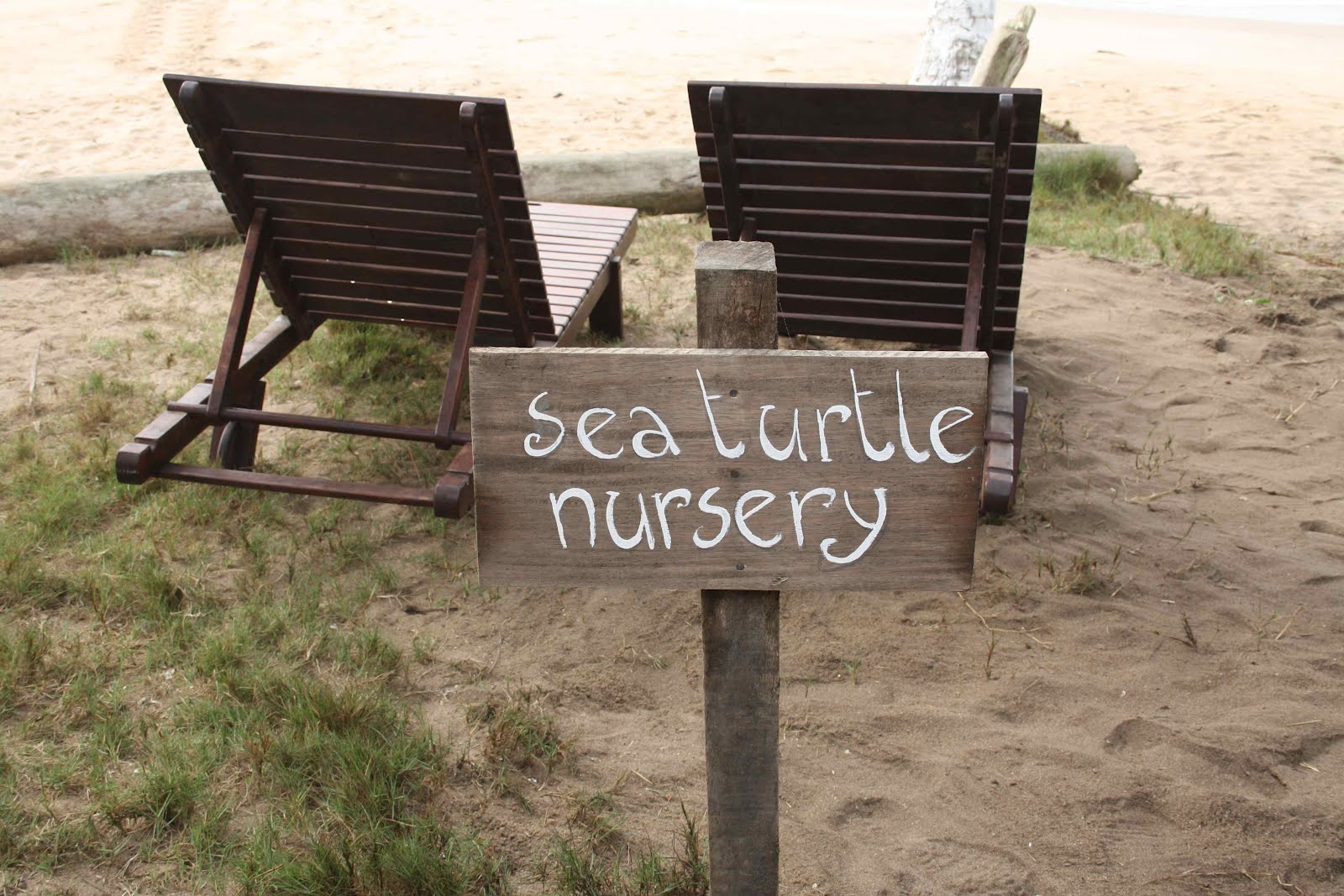
During the night, villagers from Butre had found an Olive Ridley turtle on the beach and brought it to the lodge. As part of a turtle conservation scheme on Butre beach, the owners of Fanta’s Folly and two other lodges pay local people 30 cedis for any turtles they find, as an incentive not to eat them.

As we hurried down to the beach, Sarah explained they were keeping the creature for us to see. And there she was, turned on to her back to prevent her from escaping. I felt a pang of guilt, partly that they had kept her in that position just so I could see her, and partly because I was glad they had done so. Once flipped upright, she waddled awkwardly down the sand and as soon as she reached the water she swam gracefully away, disappearing from view with the first wave.

Unfortunately the people who found her had brought her to the lodge before she had laid her eggs. It would be easy to criticise this fledgling conservation scheme; eagerness to get a reward prevents several turtles from nesting, and nests are dug up and relocated to the lodge (to stop people collecting the eggs).

But the alternative would be worse, as turtles and their eggs are considered a good meal in Ghana. Over time, local people are learning how to treat the animals and perhaps one day the eggs can also be left. The success of the similar scheme at Akwidaa shows that progress happens quickly when well managed. The Olive Ridley we saw will probably return in a couple of days to nest, and hopefully next time she won’t be spotted.

The turtle proved to be the main activity on the first day at Fanta’s Folly, a resort near Asemkow that is fully geared to relaxation. No music, no traffic, no healthy activities, just the sound of the waves and delicious French-Nigerian food prepared by the owners. A flock of black-rumped waxbills pecking for seeds was about as crazy as the morning got as we made the most of our new hammock.

But on Sunday afternoon the sound of singing in Fante drifted over from along the beach. The villagers of Butre were helping to bring in the catch from the nets set out early that morning. Once hauled in, the myriad species flapped their last breaths in the bulging net – barracuda, snapper, lobster, skate, dory and jellyfish were among the ones I recognised. Enough for a live action version of ‘Finding Nemo’, or at least a tasty chowder.

As the men carried the nets back to Butre, the women shared out the catch. Agnes, a lady living in Butre explained that she and many others had moved to the coast from the Volta region, as the livelihood from fishing better than from farming. Clearly the incomers have settled well; she spoke Fante and the whole community seemed involved in the activity, with everyone getting their reward.

As the fish were being shared out, Robert bought five barracudas for 26 cedi – the price of two in Accra – and other tourists also went away with the freshest fish they are likely to ever buy. Children sat with buckets, squabbling for the tiniest specimens that were discarded into the sand (they were used for games rather than for eating), while vultures, crows and hawks watched from a safe distance, ready to clean up once the humans had left. A brief burst of activity in one of Ghana’s sleepiest resorts.

Friday, 16 December 2011

Akwidaa

The Green Turtle Lodge on Akwidaa beach have read the ecotourism manual and ticked all the boxes. Sustainable buildings? Check – recycled materials, local designs, even compost toilets. Sustainable energy? Check – all solar-powered. Locally sourced food? Check. Local employment? Check. Conservation? Well, the name tells you everything.

They have even managed to keep the journey authentically rustic. The lodge lies several miles along what is a strong contender for the ‘worst road in Ghana’ title. Rutted doesn’t come close; at times our taxi was picking its way over medium-sized boulders scattered over a 45o slope. This would act as a barrier to many businesses, but the Green Turtle’s reputation ensures that the guests – mostly backpackers and volunteers – flock here year-round.

Hannah and I made the journey from Accra via Takoradi to enjoy a pre-Christmas break. Upon arrival, we saw why people loved it – a palm tree-lined beach stretching for miles in either direction, with the lodges hidden back in the trees as well as a bar made from an old ship. Four days was not going to be long enough.

The lodge runs one of the growing number of turtle conservation projects along the coast, and we booked to go on a turtle hike on the first evening. Along with several other visitors, all young enough to remind me it was 10 years since my volunteering days in Kefalonia, we set off along the sand. Five species of turtle nest in Ghana – green, loggerhead, olive ridley, leatherback and hawksbill – but they were all hiding that night. The walk was still enjoyable though, with phosphorescence sparkling in the waves under the bright full moon.

Life at the Green Turtle ambles by easily in a lazy haze of books, swims and delicious meals – a selection of different dishes are made each day. But by the third morning, we needed something active and booked a canoe trip along the river behind Akwidaa village.

Fufu, the Green Turtle’s dog, led us to the village where we met Ben, a local student who leads boat trips to save money so he can finish school. I was surprised when he started towing out a rotten old canoe that I’d assumed had been dumped there. This turned into to mild alarm when he fetched a small bowl. “To bail out the water”, he cheerfully explained.

The first stretch of river passed me by, as I made doubly sure that I could remove the water faster than it entered, whilst not removing the tiny hermit crab that was wandering around the boat to avoid the scoops.

Once satisfied, I relaxed and started to enjoy the mangrove forests. Ben’s keen eyes picked out cormorants, hornbills, kingfishers, toucans, and even two salamanders that slipped silently into the water. It was easy to imagine that there were plenty more species out there, hidden from view by the thick foliage.

As we entered a narrow side channel, we spotted hundreds of the red and black crabs that live in the mangroves. “Delicious”, remarked Ben, briefly forgetting his role as a wildlife guide. Still, it looked like there were plenty to go around.

We passed fishing villages on the way back, the residents waving as they cast out their nets from the bank. Ben dropped us back at Akwidaa and we walked back along the beach to the Green Turtle Lodge, content in the knowledge that all we had left to do for two days was sleep, eat and drink.

Sunday, 4 December 2011

Bojo

One downside of living in Accra is the lack of open space: few parks or gardens for pottering, and the seafront is either built up or used as a rubbish dump. In contrast, one of the best things about the city is that a short drive from the centre, you can be on a tropical beach.

Labadi is the most popular city beach but this is essentially a sandy nightclub, more geared to drinking and dancing than a lazy day. A much better option is Bojo Beach on the western edge of Accra.

This thin strip of sand sits across an estuary and boats ferry visitors across the water. It looks shallow enough for wading across, but the people who live nearby use boats; it’s always good to
follow the local example.

There is a 6 cedi entrance fee to this private beach but it’s a fair price to pay if they manage to keep it unspoilt. The beach was near-deserted, remarkable even for a Sunday morning when most people are at church: a city of 3 million people, and less than 30 of them were at the beach.

Small wooden shelters were dotted along the sand and a waiter quickly found us “the best one”, carried our bags across, then came back to t
ake our drinks order. Good service by Ghanaian standards.

And so began a typical beach day: order beer; drink beer; order food; explain that ‘veggie’ means
no fish, not even in the sauce; read book; head for a swim; realise after two minutes that Ghana’s sea is a fickle beast that will quickly toss you about like an unloved toy; rush out; restart cycle with the next bottle of beer.

As the sun set, we piled back on to the passenger boat across to where our taxi driver was waiting. The boat was busier than when we had arrived, the beach filling up during the day, but it had not lost its peaceful charm. In a country with an increasingly well-marked tourist trail, Bojo still counts as a hidden gem.

Saturday, 19 November 2011

Kpala Island

The Island of Hope Christian Academy is on Kpala Island, a small patch of land that stayed above water when Lake Volta was flooded in 1965. Ghana International School (GIS) has a partnership with the school, providing support to the teachers as well as funds and resources, and GIS staff visit each year. Always up for a free trip, I gladly tagged along.

The bus journey began in typical Ghanaian style. A prayer for our journey, then a long delay while we picked some people up at the mall, followed by breakfast and singing on the bus. The drive out to the Volta region is my favourite in Ghana (so far) so I happily sat back and watched the now-familiar villages fly past.

The real hubbub began at Kpandu, one of the main ports on the Volta’s eastern shore. The market was in full swing as we unloaded the bus with the provisions brought for the school. I climbed onto the bus roof under the pretence of helping, but actually to get a better view of the chaos below. Particularly eye-catching were the four cows neatly arranged in the back of a van, looking like to solution to a mid puzzle. On a nearby rooftop, vultures watched the action below, waiting for some fish or meat to be dropped.

Boat loaded, we were soon sailing across the calm waters of Lake Volta. We passed tiny inhabited islands on the way, little more than a few rocks; pre-1965 these were the region’s high points, now they stood out as the last refuges in the water. The fishers who lived there waved as we went past; the constant traffic across the lake means they are unlikely to feel too isolated.

The school children greeted us at Kpala Island and solemnly carried the boxes to shore on their heads. We were then given a guided tour of the school. The basic nature of the classrooms was a stark contrast to the modernity of GIS.

The teachers showing us round then led us to the school's pride and joy: a roundabout in the playground. This is not just something to keep the kids amused; it is the school’s generator, powering their new ITC centre as well as houses in the village. Just two hours of use a day is enough to power the school, and the children need little encouragement to hop on. It's an ingenious example of clean energy and hopefully will be replicated across Ghana.

After a singing and dancing presentation from the school, we ate lunch – tilapia of course, fresh from the lake that morning – before returning across the lake to Kpandu. Rarely has helping out on a school trip been so enjoyable.

Sunday, 30 October 2011

Mount Adaklu

A post-walk beer is a regular feature of walks with the Ghana Mountaineers, but this was the first time we had started drinking before the walk. But this was all in the name of good manners – sharing a bottle of gin with the chief of Helepke village as we requested permission to climb the nearby mountain, Adaklu.

We sat in the chief’s dark living room – twelve walkers from Accra and eight members of the local tourism committee – exchanging pleasantries and making arrangements for the next day’s hike. I was unsure if there was an ancient tradition that meant gin must be shared, or if the chiefs just liked it. Either way, no one complained.

Outside, the large clouds that had been gathering over the summit let loose into one of Ghana’s violent tropical storms, with Mount Adaklu taking the brunt. As we drove back to Ho, I wondered what the deluge was doing to the mud paths we would be ascending.

We were up and ready to go at 05:30 the next day and after breakfast at the Bob Coffie Hotel (twelve of the smallest omelettes I have ever seen) we set off once more for Helepke, the largest of a collection of villages that circle the base of the mountain.

At 602m, Mount Adaklu is a mountain in miniature, but still large enough to mimic Mounts Cameroon and Kilimanjaro in its ecological zones that vary as you climb. We passed through maize farms in the village to reach the foot, then through tall grasses until we reached the treeline, where huge trees provided a dense shade.

The path through the jungle was steep and rocky. Nothing tricky under normal circumstances, but the previous day’s deluge had turned it into a type of gloopy porridge, causing everyone except our sure-footed guides to slip. The trickiest section was a near-vertical series of rocks up to a large boulder. Hard enough going up, it surely crossed everyone’s mind that we would also have to go down it.

Such trifles don’t bother most Ghanaians, though. Just above the rocky cascade was a cocoa yam farm. The farmer greeted us as he passed, then leapt down the rocks in his worn-out flip-flops while balancing an overflowing basket of the heavy tubers on his head.

The rain had also brought out the forest’s huge snails, which were enjoying the moist vegetation. The youngest guide with us was delighted, and collected several for his dinner. He assured me they were delicious; I was happy to take his word for that.

Beyond the yam farm the path levelled out as we crossed the plateau of this table-topped hill, and quickly reached the top. The guides proudly showed us the shelter they had built using the profits from tourism. They hope to encourage more visitors here, and the new road being built to connect Adaklu with the popular town of Ho will certainly help. The profits are also shared between all the villages around the mountain, so everyone gets their share, however small.

The walk down proved tricky, with some finding the steep and slippery paths a trial, but we all made it back to the village safely and headed back to Ho, where Kevin had organised a traditional Ghanaian lunch for us to finish the trip: light soup and fufu.

Fufu is a thick white dough made of cassava and it is one of the few trials of living in Ghana. It is best described as like eating Play-Do but without the novelty of being an interesting colour. It can’t even be described as bland; it manages to taste of nothing in a slightly unpleasant way.

It can take several hours to pound the cassava for fufu; why anyone bothers is beyond me. I managed about three mouthfuls, then gave up and ordered some rice to go with the groundnut soup – which by contrast is a delicious local dish. Feeling brave after managing a little fufu, I ordered a glass of cocoa bean wine, made locally. How bad could it be?

Very. Tasting of gone-off chocolate, which is essentially what it was, it was a hard glass to polish off. But having failed with the fufu, I was determined not to lose culinary face again. I held my nose, downed it, then ordered a large Star to wash away the taste, safe in the knowledge that Ghanaian beer is up there with the best that the country has to offer.

Sunday, 23 October 2011

Waterfall

Near the Togo border are Wli waterfalls, one of Ghana’s most popular attractions. Our group loaded into the hire car and took the road north from Ho to Hohoe. Hotels in Ho market Wli as a ‘nearby attraction’ – a questionable claim when it is a three-hour drive, but the Volta Region is a beautiful part of Ghana, with forested hills rising above tidy village farms, so the journey is part of the fun.

The popularity of an attraction in Ghana can be roughly gauged by its booking office. At Wli this is a large room with tables and chairs, complete with adjacent snack bar and gift shop, so it must see a lot of visitors. We were assigned a guide and started off along the track to the falls. The path was still slippery following the previous day’s storms, and the fords where it crosses the outflow from the falls higher than usual, but the forest was refreshingly cool and butterflies flew about everywhere.

We heard the waterfall long before we rounded the corner to see it. It was in full spate, the water crashing around 30m out from the cliff and the spray covering the whole clearing. An impressive force of nature, only spoiled by the mounds and mounds of rubbish left in the undergrowth in every corner of the site. The waterfall was too forceful to swim in the plunge pool, so we passed the time trying (and failing) to get good photos, and getting soaked before heading back to the car. There are longer hikes around the upper waterfall as well; worth noting for a return visit.

Amedzofe

The next day we headed for one of the Volta region’s most interesting places, and also one of the most remote. High up in the Avatime Hills is the village of Amedzofe and its nearby peak Mount Gemi.

The walk to the mountain is an easy half-hour pootle; it’s the drive there that brings you out in a sweat. A series of hairpin bends ascend an increasingly bumpy and poorly kept road. Quaysie lurched the car from side to side to avoid ruts and potholes, seemingly oblivious to how close we veered to the very long and very steep drop. I was relieved to reach the village.

We called in at the small tourist office in the village and our guide led us to Mount Gemi. The name is not an ancient Twi word, but named after the German Missionaries, who built the cross on its summit that doubled as a communications device during World War II.

This was about all he managed to explain; his attention was mostly on the village football match. Football is big news in Ghana, even in isolated mountain villages, and this encounter with Fume, a neighbouring village, was particularly spicy. I couldn’t understand the chants at opposition players, but they didn’t sound like friendly encouragement.

I asked our guide how many people visit Amedzofe each week. “Sometimes about 20, sometimes none, but it is fine, they are all welcome”. It’s a refreshing approach to tourism development. While it may not boost the bank balance, it helps to keep places like Amedzofe unspoilt as they slowly adapt to tourism.

After passing a cloud of biting gnats on route – the best technique is to run through swirling a t-shirt – we reached the summit. It’s one of the highest points in the region at 611m, and the views were incredible: miles and miles of dark green hills stretching out towards Lake Volta, with dusty brown villages dotted in every pass in between. Well worth a nerve-wracking drive and a cloud of biting insects.

Before heading off, we bought some cold drinks in the village and sat in stone chairs while a bunch of old men played Damii. This is a Ghanaian game similar to draughts, the main difference being that players have to slam the pieces down and shout regularly at their opponent. They ignored us completely as they focused on the next move or insult, so we drained our bottles and headed back to Ho, and the long drive back to Accra.