Sunday, 26 May 2013

Afadjato


Mount Afadjato. Not that huge.
Mount Afadjato is Ghana’s highest mountain, reaching 885m. But the usual nicknames given to a country’s highest point are not applied here; no one describes it as ‘the rooftop of Ghana’, for example. And as you arrive at the base at Liati Wote, it’s easy to see why: Ghana’s highest mountain is surrounded by taller ones.

On the way to the top
Even the nearest peak, just across the road in the village, looks bigger. As our group from the Ghana Mountaineers pulled on walking boots and paid our hiking fees, I asked Justice, our guide, if the nearby hill was actually in Togo, given how close we were to the border. “No, but it’s much harder to reach the top”, he replied. It seems Afadjato is not even the tallest in its village; its image was quickly becoming irredeemably tarnished.

A signpost
The answer lies in the complexities of measuring summits and descents in between high points, a familiar issue to anyone who has tried to distinguish between Munros, Corbetts and Grahams in the UK. On the route up, Justice explained that the higher peaks nearby form part of a ridge that switches between Ghana­ and Togo. So while there are higher points in Ghana, Afadjato is the highest freestanding peak.

Hot, sweaty and having just been sick
I think that’s right; Justice wasn’t entirely sure, and didn’t really seem to understand why it mattered. He had a point; a good walk is a good walk, and Afadjato is certainly that. A steep path leads up its western face, with a couple of rocky climbs that provide a nod towards its ‘mountain’ status. And the views at the summit are superb: the Agumatsa Hills, coated by a dark green forest, stretch for miles to the north and south.

Also visible from the top is Tagbo Falls and after descending the hill, we continued along the low-level path to this beautiful waterfall set in a lush forested amphitheatre. The walk up Afadjato had worked up a sweat and Stephen, Quaysie and I splashed under the water to cool off. Once refreshed, we could reflect on our earlier achievement – climbing the highest hill in Ghana that’s not partly in Togo or a bit tricky to get to. Now that’s some achievement.

Tagbo Falls

Sunday, 12 May 2013

Terrapins


The road to Krobo
The markers along the early drive to Krobo were all present and correct: stalls of bread sellers at Ashaiman; baboons lingering outside the Shai Hills; early morning joggers on the Akosombo road; the police reluctantly waving our car through their checkpoint, the diplomatic number plates meaning no ‘dash’ this time.

This was my seventh trip up Krobo and the route was equally familiar. I knew every rock along the way, despite the tall grass obscuring the path. But even well-trodden hills can throw up surprises.

Snake!
Just beyond the short rock climb, Carolyn spotted a small grey snake crossing the path. This was the first snake I had seen on Krobo, and only the third in two years in Ghana – a welcome rare sighting. The bulge midway along its length suggested we were slightly less likely to see a mouse on route. After pausing while we took its picture, it slid off to digest its meal in peace.

A baby terrapin
An even bigger surprise was waiting at the top. In among the rocks at the summit is a small pool of water, which had been recently replenished by the rain. Something bobbing near the surface caught my eye; was that really a baby terrapin? I looked again and saw another further along, and another climbing the side of the pool. As we admired them, the mother, hidden in the grass, splashed into the water and disappeared into the depths of the murky pool.

Route-finding
It’s a mystery how they got there; there’s no other standing water for a long way, and the sides of Krobo are surely too steep for a terrapin to climb (and why would they bother?) Could a bird have dropped one while flying overhead? Could there be a cave system hidden within the hill, connecting them to rivers below? It is likely to remain a mystery for quite some time.

This wasn’t just a simple stroll up Krobo, however; our group continued to Stone Lodge through the scrubby plains of lowland Ghana. We took a bearing – none of this GPS nonsense, just binoculars and a compass – and set off due south.

Krobo in the background
Aside from the occasional thicket of trees, and ditches formed by cattle that were now filled with water, the route was fairly straightforward. But 14km is a long way in the heat of Ghana; as we reached Stone Lodge three hours later, I considered the fact that most of our fellow expats would – like the Krobo terrapins – have opted for a day swimming in the pool rather than a hike in the midday sun.

Monday, 6 May 2013

The big match


In the mixer
It’s West Africa’s Clásico, the regional clash of the titans. Accra Hearts of Oak, Ghana’s most successful team, against their fierce northern rivals, Kumasi Asante Kotoko. The country’s two most popular clubs meet in Ghana’s version of Chelsea versus Liverpool Man United. And … it’s a little bit rubbish.

Many of Ghana’s brightest stars are whisked off to European clubs at a young age, and those left behind seem to be running through the commentator’s cliché book: the players couldn’t trap a bag of cement, and chances go begging that the most lethargic grandmother would have buried. But both sides give 110% on the pitch and plenty of full-blooded tackles fly in.

Packed stadium
Matches at the Accra Sports Stadium are about more than the football though. The ground is nearly full, 38,000 fans wearing the bright red of Kotoko or the garish yellow-blue-red of Hearts (one of football’s more lurid kits – imagine Crystal Palace mixed with Partick Thistle, with a bit of LSD thrown in). It’s also the only place in Ghana where you see anyone wearing a scarf.

A Hearts fan
Vuvuzelas buzz across the stadium, far louder than they seem on TV and every bit as annoying. People sing and dance together, and after every key moment men stand up and start a fierce argument with someone nearby – anyone will do, even if they agree with you. It’s a furious burst of shouting and finger pointing, then smiles all round and back to the game.

And..... he missed
A rare moment of skill lights up the first half. Wilfred Kobina, the Hearts midfielder, runs towards the box. As fans in the upper tier take cover, he surprises everyone by drilling the ball into the bottom corner. The Hearts players run off to celebrate and the stadium erupts on all sides. Cue even more shouting and finger-jabbing.

At half time, the crowd join in with Hearts’ endearing chant: ‘Arise arise arise, be quiet and don't be silly, we are the famous Hearts of Oak, we Never Say Die’. Fans pour outside to buy grilled kebabs and popcorn and mingle with the opposition. It’s all remarkably civilised for the nation’s biggest rivalry; perhaps the memory of Ghana’s worst stadium disaster, in which 127 people died, is still too fresh in people’s memories for any aggression.

The Kotoko teddy
The second half starts at a noticeably slower pace, Ghana’s intolerable afternoon heat taking its toll. The fans find new ways to entertain themselves. A poor offside decision leads to a volley of water bottles thrown towards the offending linesman; one hits him squarely on the backside, which satisfies everyone. An ever-growing throng dances around the stand, carrying above them a giant teddy bear bedecked in Kotoko colours. They seem to have more energy than the players by this late stage.

Kotoko equalise through a scrappy header following a goalmouth scramble, and apart from a few late chances for Hearts, the game peters out to a 1-1 draw. The spoils are shared and both sets of fans head home happy with the result. But that doesn’t stop them arguing furiously outside the stadium, about offside decisions, missed chances, and which side has the best teddy bear.

Sunday, 14 April 2013

Obroni


Butre beach
Stirring myself from the sun lounger at Fanta’s Folly, I walk along the beach to Butre, one of Ghana’s popular coastal villages. Small, near-translucent crabs scuttle towards their holes in the sand as I pass; they pause on the edge, waiting to see how close I will get before disappearing from view.

Across the wooden bridge that spans the river between the beach and the village, I wave at a group of teenagers, anticipating a chorus of ‘obroni. But they are too engrossed in their game of damii to notice me.

I look for a path to Fort Batenstein, which sits on a small hill overlooking the village. There is no obvious way up through the haphazard houses, and no one offers directions as I walk through the main street. But at a school on the edge of Butre, a man asks me where I’m going. I answer him; he tells me I need a guide to visit the fort. ‘It’s illegitimate to go without out one’, he smiles. I smile back, deciding not to correct his mistake.
Bridge

In the village, I soon find the simple wooden shack that acts as Butre’s tourist information centre. The teenage girl outside looks up at me impassively. I ask to visit the fort.
‘OK, let’s go.’
‘How much?’
‘Five cedis.’
‘Too much, I’m not paying that much.’
‘Then you’re not going.’

She grins broadly. I wonder whether she is pleased to have outwitted the sweaty white man, or simply to have avoided a walk in the searing sun.

Sandy
Instead, I head to the harbour. Men sit in groups mending their nets; they look up and nod curtly, not hostile but indifferent to yet another tourist with a camera trying to photograph their boats.

The children splashing in the water are more responsive. ‘Obroni, snap me’. They strut and pose for the camera, then crowd around to see themselves in the viewfinder. I take a deep breath as then sandy little hands grab at my expensive camera, reminding myself it can be cleaned. ‘Obroni, give me one cedi’ they then ask, an almost Pavlovian reaction to seeing a white person. They don’t seem to really expect a response, running back into the water, and I don’t give one.

Butre harbour
I walk back along the beach and notice that most of the fishermen have discarded their nets. I ponder why, then spot a chalk notice on a board outside a bar: ‘Rubin Kazan v Chelsea, 4pm’. The cheers from inside suggests Chelsea have scored already (I have yet to meet a Rubin Kazan fan in Ghana).

Back across the bridge, I stop for a drink at the Johannesburg bar. The couple that own it pause their argument to serve me a chilled Star beer. The toothless old man next to me starts talking in broken English. ‘Visit … photo … leave … drink.’ A hand gesture confirms he wants, or expects, me to buy him a beer too.

I consider whether buying him one would reinforce stereotypes of tourists as cash points, or be a kind gesture to a poor man on a hot day. Then realise I only have four cedis on me. I pretend that I don’t understand him, pay up and leave hurriedly.

On the beach outside, a young rasta leans over his shoulder, smiles and waves. ‘Hey, obroni, how are you?’ A small dark pool is forming on the beach in front of him. ‘Fine, how are you?’ I wave back, making a mental reminder that talking to people mid-piss won’t be normal when I move back to Germany in two months.

Boat

Thursday, 11 April 2013

Butterflies


Not Kumasi
The Lonely Planet’s West Africa guidebook says ‘Kumasi is worth as much time as you can give it’. Hmm … my first five minutes in Ghana’s second city were spent picking a route through Kajeita market – through open sewers, ankle-deep rubbish, and street traders who cover the pavement with cheap plastic tat and piles of fruit. Five minutes was more than enough time for me.

Perhaps the best way to enjoy Kumasi is not to live in Accra. The ‘sizzling street food’, ‘colourful markets’ and ‘bustling/vibrant/hectic/pulsating nightlife’ may be exciting the first time, but the novelty quickly wears off. Kumasi had the same hassles, traffic and potent stenches that Hannah and I were escaping for two weeks.

That evening we got food poisoning from an expensive Indian restaurant and were greeted in our hotel room by a cockroach the size of a cat. I was more than happy to leave Kumasi early the next morning to explore the countryside of the Ashanti region.

*****
Lake Point Guesthouse
It’s an unfair comparison: a crowded city of 1.6 million people versus a tranquil lakeside retreat. But Lake Bosumtwe felt a world away from Kumasi. Formed by a meteorite several millennia ago, the near-perfectly round lake is surrounded by quiet fishing villages and forested peaks – not a bustling market in sight.

We took a taxi to Lake Point Guesthouse on the western shore of the lake. Our room was charmingly furnished with local materials and adornments. In the garden, birds flitted between the flowers and star fruits, mangoes, bananas and oranges hung from the branches of the various trees. I could feel the grime of Kumasi leaving me instantly.

Star fruit
We spent the day lazing by the lake, reading books and playing scrabble. Beside the lake, the only noise came from the raucous weaverbirds that were nesting in the reeds. The shallow lake water was as warm as a bath, and an eagle swooped overhead as I swam. This was my kind of place.

It’s hard not to fall into the relaxed vibe of life beside the lake. Unfortunately the staff at Lake Point had done likewise. The next day, we asked about the lunch menu – a limited but tasty selection of soups with bread or toasted sandwiches. We were told that they had run out of bread at breakfast and were waiting to get some more.

A cattle egret relaxing at the lake
Breakfast had finished four hours ago; the nearest village, complete with a stall selling bread, was a mere 10 minutes’ walk away. I asked if they could get some bread: ‘Someone has gone already’. When will they be back? ‘I don’t know’.  Can you prepare soup and bread when they are back, and bring it to us? ‘No, you must wait.’

It’s a minor gripe, and lethargic customer service is hardly a new complaint in Ghana. And if you’re going to wait for two hours for a bowl of soup, there are few more relaxing places to do it than Lake Bosumtwe.

*****
A butterfly
The Ashanti region is Ghana’s traditional heartland, as well as being the source of much of the country’s wealth, particularly from the region’s goldmines. There are plenty of craft villages nearby, but as with bustling markets, you only need to see Kente weaving once to get the idea. Instead, we decided to visit Bobiri butterfly sanctuary. 

It was a good decision. Situated just off the Kumasi–Accra road, the forest sanctuary is surprisingly well preserved considering that logging has decimated much of the region’s forests. And you don’t have to go far to see its eponymous residents.
Another butterfly

There were butterflies on every bush in the garden as we dropped off our bags; several different species flitted about on the road through the forest; one or two even found their way into the sanctuary’s guesthouse. Filling in the guestbook, I noted the previous visitor was ‘disappointed not to see any butterflies’; I wondered exactly where he had been looking.
'I saw her first...'
 
We were soon on a forest trail with James – the only wildlife guide who wears polished slip-on shoes and an ironed white shirt. He identified the different trees and told us how people use each one. He also explained the threats facing Ghana’s forests as the demand for timber rises – part of the forest is selectively logged. 

The forest was also alive with many of the 400 butterfly species recorded in the sanctuary. Although how anyone records them is beyond me – butterflies rarely sit still long enough to be examined, the little scamps.

Breakfast at Bobiri
That evening, we relaxed in the sanctuary’s guesthouse, a painted wooden house built on stilts. It felt like a trip back from the 1930s – sipping drinks on the terrace, looking out to the forest. The only thing missing from a full Happy Valley experience was the wife swapping – not easy when you’re the only guests –although two of the resident tortoises were scrapping over a lady. (If you’ve never seen lovesick tortoises fighting, I can assure you it’s very entertaining.)

I stretched out, beer in hand and with the sounds of the rain forest all around. Kumasi may delight backpackers, and Bosumtwe has its charms, but for me, Bobiri and its butterflies are the highlight of the Ashanti region.

Monday, 8 April 2013

Hippos


A hippo
Weichau hippo sanctuary feels a long way from anywhere. We rattled along the bumpy, potholed road from Mole National Park for four hours before reaching the sanctuary’s visitor centre. Jo, our guide, showed us inside while KK, our driver, surveyed his mud-splattered car with the look of a man who regretted spending an hour washing it that morning. After paying the entrance fee, I asked Jo where the hippos were. ‘We have to drive; it’s another 22km along a dirt road’. KK didn’t look like he wanted to see hippos anymore; I was beginning to wonder myself.

We headed towards the Black Volta River, past the small communities who together created the sanctuary. I should have admired this remarkable community-based ecotourism project; instead I wondered when it was lunchtime and if it was too late to head for a hotel in Wa.

A young hippo
A dugout canoe was waiting on the river, which flows along the border between Ghana and Burkina Faso. We climbed in and were paddled upstream. And just five minutes later, we saw them. A bloat of hippos, submerged in the centre of the river. They rose one by one to snort out air, nudge each other or, on several occasions, fart loudly.

We pulled into the undergrowth on the Burkinabe side of the river and watched them. There’s something enthrallingly special about being 20 metres from wild hippos – about as close as I’d want to be. As each head appeared slowly, it was hard to shake the feeling they were keeping an eye on us, checking that we were keeping our distance.

The hippos have been protected since 1999, when the local communities created the sanctuary to generate a bit more tourism revenue in this quiet corner of Ghana. The scheme has been a success: visitor numbers have increased steadily and so, more importantly, have hippo numbers.

Our canoe
Numbers may get a further boost shortly. The hippos in Bui National Park, further along the Black Volta, are under threat from the new hydropower dam. Weichau sanctuary and Ghanaian wildlife groups hope they will move upstream. They will have to make their own way, though; no one has yet offered to move these giant, grumpy beasts. There are also doubts whether the land around Weichau could support more hippos. There’s plenty of space in the water – the problems will arise when they come on land to graze, threatening local crops.

Hidden in the shade, with the two young hippos now jumping on each other, it would have been easy to stay for longer. But tummies were rumbling; I illegally entered Burkina Faso for a quick piss, and we headed back to Weichau, leaving the hippos to enjoy their serene sanctuary.

*****
Ghana does tropical storms like few other countries, and the one during our night camping near the river was a classic. The lightning was so bright that the cockerels started crowing at 3.00am, thinking it was morning. We had to move our tent in the middle of the night to avoid a drenching.

Next morning, our charcoal burner was too wet too cook breakfast on, so we headed into Weichau village to eat. Jo took us to Yussif’s Tea Spot, whose motto is ‘Call in for all kinds of beverages’. As long as it’s Lipton Yellow Label tea. Still, at least Yussif acknowledged how lacking in flavour this shameful British brand is and put two bags into my plastic mug.

Mmm, Lipton!
Four of our six eggs had survived the storm and were soon being turned into an omelette. The tins of Heinz baked beans caused a problem, however. After explaining to Yussif that they didn’t go in the omelette, he then tried to fry them. It took a bit of discussion – Yussif was mute, so Hannah and I first had to explain to Jo how to cook beans, and he then signed this to Yussif. The expression on Jo’s face when he ate them was similar to my first fufu experience – people actually like this stuff? – but he ate them all, and Yussif’s fine breakfast restored our spirits after a wet night.
Mmm, beans!

Sipping my syrupy tea, I revised my opinion from the previous day. Weichau is a wonderful place and the local people deserve huge credit for their project. It’s well worth visiting – just don’t expect the journey there to be easy. And maybe leave the beans behind.

Friday, 5 April 2013

Tick lists

There’s no mistaking a birdwatching enthusiast. Zechariah, wearing a dark green uniform complete with an ancient-looking rifle over his shoulder, was waiting at the safari office in Mole National Park when I arrived at 5.45am. ‘I was up at four, looking for fishing owls’ he explained. ‘Didn’t see them, just heard them.’ This was a man who took twitching seriously.

Mole National Park
Seriously enough to knock on the door of the two guests who had failed to show up. He came back, shaking his head disbelievingly: ‘They didn’t come, because of the storm’. The downpour just an hour earlier had been torrential; it seemed a viable excuse to me. But I opted to hold my tongue.

It was soon my turn anyway. ‘You’re too young to be a birdwatcher’, he said, looking me up and down. ‘Do you have a camera and notebook?’ I told him that I wasn’t too serious about birdwatching, and just enjoyed seeing tropical birds. The look he gave me in response left me wondering if I would make it past the crocodiles in the water hole.

But credit where it’s due: Zechariah Wareh knows his birds. As we made our way down the steep escarpment in front of the Mole Motel, he picked out various weavers and seed-crackers and the colourful red-cheeked cordon-bleu. He knew them not just by sight, but also by call; while I tried to find one species through my binoculars, he was already calling out the next one. Mole has over 300 species of bird, and he seemed keen to show me all of them.
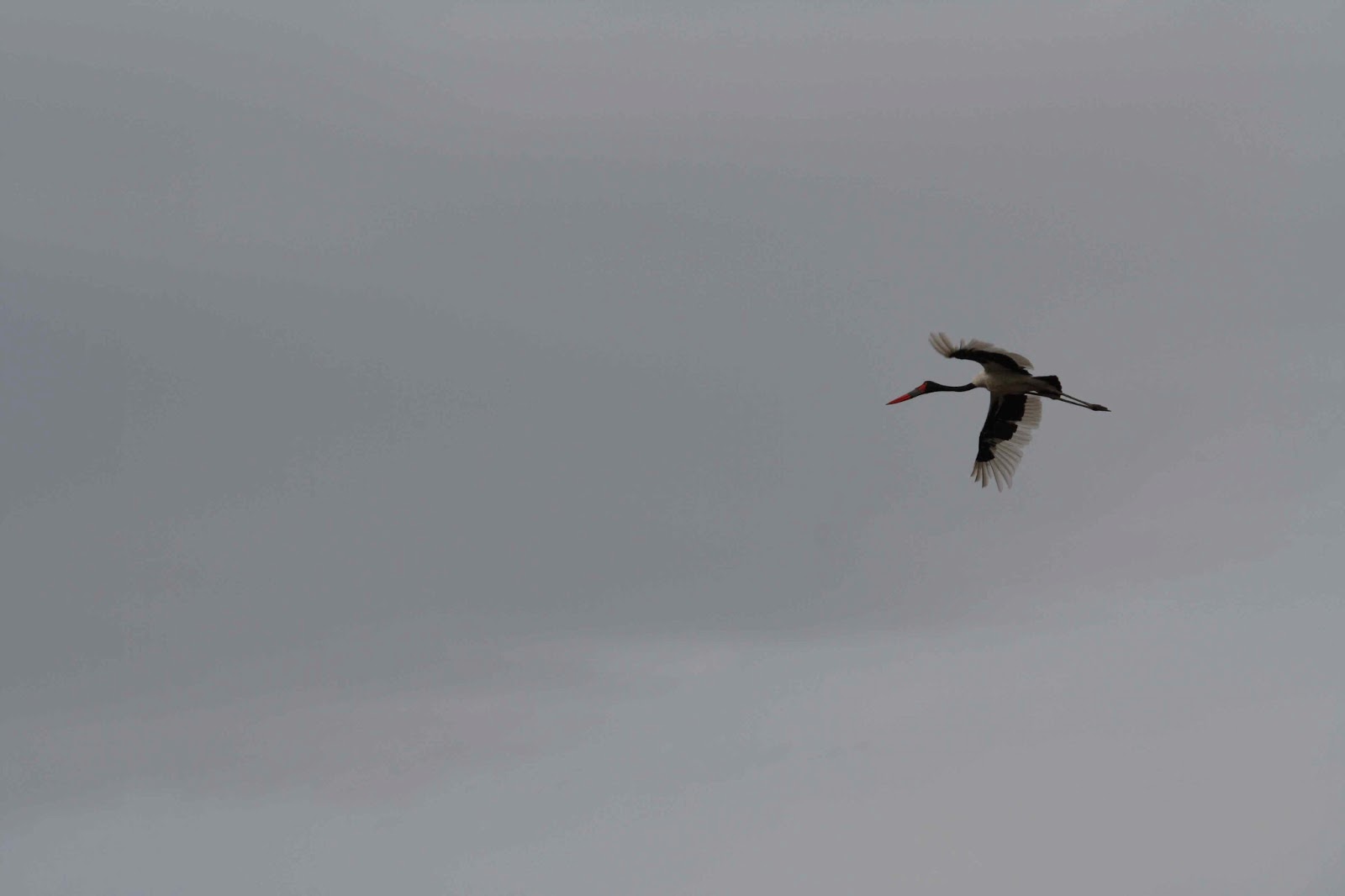
A red-billed stork

As we walked through the scrubby savannah forest, he mentioned how lucky I was to have him for this walk. He had been booked on a course, but as the other birding guide had called in sick, he had stayed to take me out. ‘I am in the Bradt guide’, he said, not boastfully but rightfully proud of his reputation.

He also told me about two avid twitchers who had spent nearly a week in the National Park looking for the rare painted snipe. ‘They are wasting their time; it has gone for the year’, he said emphatically. ‘I have told them.’ I was surprised that anyone would doubt his word on avian matters. 

Keen to redeem myself a little, I mentioned the red-billed stork I had seen the previous day. He smiled and nodded; I was starting to make amends for my lack of years or tick-list.

Crocs
For two hours, we wandered about, viewing gonoleks, starlings and vultures, among others. I lost count of the species we had seen, and was grateful I hadn’t had tried to keep a record. As we returned to the motel, we passed the crocodiles at the water hole. Zechariah stopped, admiring the creatures as they basked in the morning sun. It was warming that, after 25 years as a guide, he was still awed by a sight he must have seen nearly every day.

By this time I was hungry and, well, a little ‘birded out’. As I trotted quickly up the steps towards breakfast, Zechariah called me back. ‘Look, fruit pigeons – three different species’ he said, pointing to the colourful birds, which put their dour UK cousins to shame. I looked up, muttered something appreciative and then headed off for breakfast. Zechariah headed off to the office, and I was fairly sure he would be out there at 4.00am next day looking for his owls.